This is the full developer documentation for Endue AI
# Endue Docs
> Endue gives your AI agents an identity, connects them to the tools you already use, and keeps you in control of what they do.
Endue is a platform for AI agents that do real work. You give an agent an identity and a purpose, connect it to the tools you already use, and it runs — in a conversation, on a schedule, or triggered by an event — while you keep control of every action that leaves your account.
## Get started
[Section titled “Get started”](#get-started)
Endue runs on several surfaces. They all talk to the same agents, conversations, and history, so you can start on one and continue on another. Pick where you want to begin.
* Web
The full Endue workspace in your browser. Build agents, chat with them, connect tools, schedule routines, and review everything they produce — no install.
Open Endue and sign in, then follow the [Quickstart](/docs/get-started/quickstart/) to build your first agent.
This is the recommended place to start, and the surface the rest of these docs show by default.
* Desktop
A native desktop app for macOS, Windows, and Linux. Same workspace as the web, plus the ability to host agent runs on your own machine so they can reach local files and tools.
Setup docs in progress
Desktop install and pairing instructions are being written. See [Surfaces](/docs/get-started/surfaces/) for what the desktop app does today.
* Mobile
iOS and Android apps for checking in on agents that are already running: read what they produced, answer a question an agent asked, and approve or reject an action it wants to take.
Setup docs in progress
Mobile install instructions are being written. See [Surfaces](/docs/get-started/surfaces/).
* CLI
A single `endue` binary that is both a local runtime and a command-line client — `endue chat` for an interactive session, `endue run` for one-shot tasks you can pipe into other tools.
Setup docs in progress
The CLI is not yet generally available. See [Surfaces](/docs/get-started/surfaces/) for the commands it exposes.
## What you can do
[Section titled “What you can do”](#what-you-can-do)
Give an agent an identity, not just a prompt
An Endue agent is a durable thing, not a chat window. It has a name and handle, a profile, a character, and a system prompt kept under revision history — so you can change how it behaves and roll back when a change makes it worse.
Agents you build are addressable by handle, and the same agent shows up wherever you work with it.
→ [Build your agent](/docs/get-started/core-concepts/#agent)
Connect the tools you already use
Connect an agent to more than thirty services — Gmail and Google Workspace, Slack, Notion, Linear, GitLab, Shopify, Figma, Datadog and the rest. Once connected, the agent can search, read, create, and send within the accounts you authorized — nothing more.
Each connection is scoped to your account, bound to the agents you choose, and can be revoked at any time.
→ [Available connectors](/docs/connect/available-connectors/)
Teach it skills instead of rewriting prompts
A skill packages a repeatable job — a checklist, a procedure, a set of commands — so you can bind it to an agent and reuse it. An agent can also ask for a skill it is not yet allowed to use, and you decide in the conversation whether to grant it.
Let it remember what matters
Agents can store what they learn about you and your work, and recall it in later conversations. Memory is explicit and inspectable: you can see what an agent remembered and remove anything that should not have been kept.
Put recurring work on a schedule
Turn a task into a routine that runs on a schedule — a morning digest, a weekly report, an overnight check. Routines run whether or not you are in the app, and what they produce lands in your workspace waiting for you.
Get artifacts, not walls of text
When an agent produces something worth keeping — a report, a document, a diagram — it becomes an artifact with its own page and a shareable link. You can hand that link to someone outside your workspace without giving them access to anything else.
→ [Artifacts](/docs/capabilities/artifacts/)
Stay in control while it runs
You are not locked out once a run starts. Steer it mid-flight with a correction, and approve or reject any action that sends something out of your account or destroys data. Nothing outbound happens without your say-so.
→ [Core concepts: Run](/docs/get-started/core-concepts/#run)
Organize work into projects and spaces
Group related conversations, artifacts, and routines into a project so an agent has the right context. Spaces let a team share agents and the work they produce.
## Find the right page
[Section titled “Find the right page”](#find-the-right-page)
| I want to… | Start here |
| ------------------------------------------------------ | ------------------------------------------------------ |
| Build my first agent and talk to it | [Quickstart](/docs/get-started/quickstart/) |
| Understand what an agent, run, or artifact actually is | [Core concepts](/docs/get-started/core-concepts/) |
| Know why an agent did what it did | [How Endue works](/docs/get-started/how-it-works/) |
| Write a system prompt that actually works | [System prompt and revisions](/docs/build/system-prompt/) |
| Get better results from an agent I already built | [Testing and iterating](/docs/build/iterating/) |
| Connect Gmail, Slack, Notion, or something else | [Available connectors](/docs/connect/available-connectors/) |
| Put a recurring job on a schedule | [Routines](/docs/automate/routines/) |
| Understand what an agent can and cannot reach | [Security and permissions](/docs/account/security/) |
| Work out why something went wrong | [Troubleshooting](/docs/troubleshooting/) |
| Know which app to install | [Surfaces](/docs/get-started/surfaces/) |
| Look up a term I saw in the product | [Glossary](/docs/get-started/glossary/) |
Reading these docs with an agent
Every page is available as plain Markdown, and the whole site is indexed at [`/llms.txt`](/docs/llms.txt) and [`/llms-full.txt`](/docs/llms-full.txt). Point an agent at either one and it can answer questions about Endue from the current docs.
## Next steps
[Section titled “Next steps”](#next-steps)
[Quickstart](/docs/get-started/quickstart/)Build an agent, connect a tool, and get your first real result.
[Core concepts](/docs/get-started/core-concepts/)Agents, conversations, runs, skills, connectors, memory, artifacts.
[How Endue works](/docs/get-started/how-it-works/)The loop behind every run, what an agent can see, and why runs pause.
[Build your agent](/docs/build/agent-builder/)Identity, system prompt, model — everything that decides how an agent behaves.
[Connect your tools](/docs/connect/overview/)More than thirty services, and the binding model that keeps access narrow.
## Getting help
[Section titled “Getting help”](#getting-help)
* **Search these docs** — press `Ctrl`/`⌘` + `K` from any page.
* **Look up a term** — the [Glossary](/docs/get-started/glossary/) defines everything you can see in the product.
* **Email us** — .
# Page not found
> That page does not exist, or it moved.
If you followed a link from inside these docs, that is a bug on our side — please tell us. Otherwise, try the search at the top of the page, or start from [Core concepts](/docs/get-started/core-concepts/).
# Bring your own key
> Use your own model-provider credentials for an agent's model calls instead of Endue's allowance.
**Bring your own key** (BYOK) means Endue makes model calls with *your* provider credentials. The provider bills you directly, and those calls do not draw on your Endue allowance.
## When to use it
[Section titled “When to use it”](#when-to-use-it)
* You already have provider credit or negotiated pricing.
* Your organization requires model traffic to run under its own account for billing or audit reasons.
* You want a model that your own account has access to.
If none of those apply, the built-in allowance is simpler — there is nothing to set up and nothing to keep topped up.
## Set it up
[Section titled “Set it up”](#set-it-up)
1. **Create a key** in your model provider’s dashboard.
2. **Open Settings → Account → LLM key** in Endue and paste it.
3. **Check that it works** by running a normal conversation and watching the run complete.
A key is a credential
Anyone who can spend your key can run up a bill against it. Set a spending limit at the provider, and rotate the key if you suspect it has leaked. Rotating means creating a new key at the provider and replacing it in Endue — old and new keys are not interchangeable mid-run.
## What changes and what does not
[Section titled “What changes and what does not”](#what-changes-and-what-does-not)
| Changes | Stays the same |
| ---------------------------------------------------------- | --------------------------------------------------------------------------------------------------------------------------------------- |
| Who pays for model calls | Everything about how agents behave |
| Which models you can reach — your account’s access applies | [Approvals](/docs/work/approvals/), [connectors](/docs/connect/overview/), [memory](/docs/capabilities/memory/), [artifacts](/docs/capabilities/artifacts/) |
| Where the bill arrives | Endue’s own subscription, which still applies |
BYOK covers model calls. It does not change your Endue plan or make the product free.
## If the key stops working
[Section titled “If the key stops working”](#if-the-key-stops-working)
A revoked, expired, or out-of-credit key makes runs fail at the model step. The symptom is a run that ends with an error before the agent does any work.
Check, in order: the key is still valid at the provider, the account has credit, and the model you selected is one your account can reach.
## Limits
[Section titled “Limits”](#limits)
* The key is set per account, not per agent.
* Runs fail if the key is invalid. There is no automatic fall back to Endue’s allowance.
* Provider rate limits are yours. A busy [routine](/docs/automate/routines/) can hit them.
* Costs incurred under your own key are visible at the provider, not in Endue’s usage view.
## Related
[Section titled “Related”](#related)
[Plans and usage](/docs/account/plans-and-usage/)What consumes the built-in allowance.
[Choosing a model](/docs/build/models/)The catalog, and what each model costs to run.
[Security and permissions](/docs/account/security/)How credentials are handled.
# Plans and usage
> What consumes your allowance, how the weekly limit works, and where to see how much you have used.
Endue meters the thing that actually costs money: **model usage**. Everything else — agents, conversations, artifacts, connectors — is not billed per action.
## What consumes usage
[Section titled “What consumes usage”](#what-consumes-usage)
Every [run](/docs/work/runs/) sends your conversation, the agent’s prompt, and its tool results to a model, and the model answers. Both directions count.
That means usage is driven by:
| Driver | Effect |
| ------------------------------------------------------- | ----------------------------------------------------------------------------- |
| **Which model** | The largest factor by far — prices across the catalog differ by more than 10× |
| **[Reasoning effort](/docs/build/models/#reasoning-effort)** | Higher effort spends more tokens before answering |
| **How many steps a run takes** | Each tool result goes back into the model |
| **Conversation length** | A long thread is re-read on every step |
| **[Routines](/docs/automate/routines/)** | They run whether or not you are watching, on their own schedule |
## The weekly limit
[Section titled “The weekly limit”](#the-weekly-limit)
Your plan carries an allowance measured over a **rolling week**, not a monthly balance you can spend all at once. When the week’s allowance is used up, runs are declined until the window moves on.
Two consequences worth planning around:
* A single heavy day cannot exhaust a month.
* A routine on a short interval with an expensive model is the most common way to hit the limit, because it spends steadily while you are not watching.
Where to see the current numbers
Your plan, its allowance, and what you have used are in **Settings → Usage**. Current prices and what each plan includes are on the pricing page in the app — those change, and the app is the authoritative place to read them.
## Keeping usage down
[Section titled “Keeping usage down”](#keeping-usage-down)
In rough order of effect:
1. **Match the model to the job.** A fast, cheap model for routine work, a strong one for the few hard messages. See [Choosing a model](/docs/build/models/).
2. **Pin a model on each routine**, so scheduled work has a predictable cost.
3. **Lower reasoning effort** for work that is not multi-step.
4. **Start new conversations** when the topic changes — long threads are re-sent on every step.
5. **Turn off [built-in tool groups](/docs/capabilities/built-in-tools/)** an agent does not need; every advertised tool is context on every step.
6. **Widen routine intervals.** Hourly is rarely worth four times what four-hourly costs.
## Bring your own key
[Section titled “Bring your own key”](#bring-your-own-key)
If you would rather pay a model provider directly, connect your own key and Endue will use it for that model’s calls. See [Bring your own key](/docs/account/bring-your-own-key/).
## Limits
[Section titled “Limits”](#limits)
* Usage is metered per account, not per agent. The usage view shows the account total.
* Runs are declined when the weekly allowance is exhausted. Work in flight is not rolled back, but new runs will not start.
* Figures in the usage view can lag a run by a short period while it is settled.
## Related
[Section titled “Related”](#related)
[Choosing a model](/docs/build/models/)The single biggest lever on what you spend.
[Bring your own key](/docs/account/bring-your-own-key/)Pay the provider directly instead.
[Routines](/docs/automate/routines/)Scheduled work — the usage you are least likely to notice.
# Security and permissions
> What an agent can reach, what stops it, how credentials are held, and how to withdraw access.
An Endue agent can only reach what you have given it, and cannot take an irreversible action without you. This page is the whole model in one place.
## What an agent can reach
[Section titled “What an agent can reach”](#what-an-agent-can-reach)
An agent starts with nothing but reasoning, arithmetic, the current time, and public web pages. Everything beyond that is something you added:
| Reach | Comes from | Scope |
| --------------------- | ----------------------------------------------------------------------------- | ------------------------------ |
| A service you use | A [connection](/docs/connect/overview/) you authorized **and** bound to this agent | That account, those operations |
| A packaged procedure | A [skill](/docs/capabilities/skills/) bound to this agent | What the skill’s steps do |
| Built-in capabilities | [Tool groups](/docs/capabilities/built-in-tools/) left switched on | Your Endue workspace |
| Facts about you | What it stored in [memory](/docs/capabilities/memory/) | This agent only |
## What it cannot reach
[Section titled “What it cannot reach”](#what-it-cannot-reach)
* **Other agents’ conversations, memory, and bindings.** Agents are isolated from each other.
* **Its own other threads.** A [conversation](/docs/work/conversations/) does not read across to another.
* **Services you have not connected.** There is no generic “call any API” capability.
* **Operations a connector does not expose.** Each connector has a fixed list — see [Available connectors](/docs/connect/available-connectors/).
* **Anything on your own machine**, for runs on Endue’s servers.
## The gate in front of irreversible actions
[Section titled “The gate in front of irreversible actions”](#the-gate-in-front-of-irreversible-actions)
Every connector operation is classified. **Send** (anything that leaves your account and reaches someone else) and **destructive** (anything that deletes or overwrites) stop and show you the exact action with the exact arguments before running.
The gate cannot be switched off
There is no per-agent or per-account setting that lets an agent send or delete without asking. In an unattended run — a [routine](/docs/automate/routines/) or a [channel](/docs/automate/channels/) — such an action is refused rather than performed.
Approving authorizes *that action with those arguments*, once. The next one asks again.
## How credentials are held
[Section titled “How credentials are held”](#how-credentials-are-held)
When you authorize a connector, Endue stores the resulting token — never your password, which you enter at the provider, not in Endue. Stored credentials are encrypted, and they are used only to make the calls the connector’s operations describe.
Model-provider keys you supply under [BYOK](/docs/account/bring-your-own-key/) are handled the same way.
## Withdrawing access
[Section titled “Withdrawing access”](#withdrawing-access)
| To withdraw | Do this | Effect |
| --------------------------------------------- | --------------------------------------------------------------- | ------------------------------------------------- |
| One agent’s access to a service | Unbind the connection in [Agent Builder](/docs/build/agent-builder/) | Immediate, for that agent |
| All agents’ access | Remove the connection in Endue | Immediate, everywhere |
| Endue’s access entirely | Revoke at the provider as well | Endue can no longer call, even with a stale token |
| A shared [artifact](/docs/capabilities/artifacts/) | Turn link sharing off | The link stops working |
For a clean break, do both the Endue side and the provider side — removing a connection in Endue does not revoke Endue’s registration at the provider.
## Practical advice
[Section titled “Practical advice”](#practical-advice)
* **Bind narrowly.** The agent that drafts your emails does not need your production dashboards.
* **Be careful with channel-facing agents.** Anyone who can reach the bot can talk to the agent, so an agent exposed in a [channel](/docs/automate/channels/) should not hold sensitive connections.
* **Read approval prompts.** They exist so you can catch the wrong recipient, and they name it.
* **Read what you share.** An artifact written from your mail may quote it; a share link is public to anyone who has it.
* **Review memory occasionally.** Agents write down what they infer, and you can delete what should not be there.
## Related
[Section titled “Related”](#related)
[Approvals](/docs/work/approvals/)The gate itself, and how it behaves unattended.
[Connectors overview](/docs/connect/overview/)Connection versus binding — the core of the access model.
[Troubleshooting connections](/docs/connect/troubleshooting/)Revoking, re-authorizing, and the wrong account.
# Channels
> Reach an agent from Discord, Slack, KakaoTalk, NaverTalk, or WhatsApp — how pairing works, who is allowed to invoke it, and what an agent will not do there.
A **channel** lets people reach an agent from outside Endue. Pair an agent to a messaging platform and it answers there, in the thread, without anyone opening Endue.
## When to use it
[Section titled “When to use it”](#when-to-use-it)
When the people who need the agent are already somewhere else — a team in Slack, a community in Discord, customers messaging your business on KakaoTalk, NaverTalk, or WhatsApp. A channel puts the agent where the question is asked.
This is the opposite direction from the [Slack connector](/docs/connect/slack/), which lets an agent *read and write in* a chat service as part of its own work. The two are independent, and you can use both.
## Available channels
[Section titled “Available channels”](#available-channels)
| Channel | How it connects | How people call the agent |
| ------------- | ----------------------------------------------------------------------------- | --------------------------------------- |
| **Discord** | Paste a bot token — server, endpoint, and allow list are worked out for you | `/ask` in the server |
| **Slack** | Two tokens from your Slack app (Socket Mode — no public endpoint needed) | Mention the app; it replies in a thread |
| **KakaoTalk** | Paste the webhook URL Endue issues into your chatbot builder’s skill server | Message the channel |
| **NaverTalk** | Enter the outbound API key, paste the webhook URL into Partner Center | Message the TalkTalk account |
| **WhatsApp** | Enter the Cloud API access token, register the webhook URL with your Meta app | Message the business number |
| **Telegram** | — | Coming soon |
Two shapes underneath: for Discord and Slack, Endue holds a token and talks *out* to the platform. For KakaoTalk, NaverTalk, and WhatsApp, the platform calls *in* to a webhook URL Endue issues — you paste that URL into the provider’s console. NaverTalk and WhatsApp also need an outbound credential, because replying requires their own authentication.
## Pair a channel
[Section titled “Pair a channel”](#pair-a-channel)
1. **Open Channels** in [Agent Builder](/docs/build/agent-builder/), under the agent’s Pairing section, and pick the provider.
2. **Fill in what that provider needs** — a bot token, two app tokens, or an outbound key. The form names each field.
3. **For inbound providers, copy the webhook URL Endue shows you** and paste it into the provider’s console: the KakaoTalk chatbot builder’s skill server, NaverTalk’s Partner Center, or your Meta app’s webhook settings.
4. **For Discord and Slack, invite the bot to the server or workspace.**
Invite the bot before you expect it to answer
A paired channel whose bot has not been invited looks connected but never responds. If a channel goes quiet after working, check that the bot is still in the server and reconnect the pairing if it was removed.
## Who is allowed to invoke it
[Section titled “Who is allowed to invoke it”](#who-is-allowed-to-invoke-it)
A channel is a door into an agent that has your connections bound to it, so every pairing carries an invocation policy:
| Policy | Who can invoke |
| --------------------------- | ------------------------------------------------------------------ |
| **Only me** | The account that paired the channel, plus anyone on the allow list |
| **Only listed people** | The allow list, and nobody else |
| **Everyone in the channel** | Anyone who can reach the bot in that server or workspace |
Someone who is not allowed gets a short refusal rather than silence, and their request appears in the pairing’s panel — you can add them to the allow list from there, or add an ID by hand.
Open channels are open to everyone present
“Everyone in the channel” means every member of that server or workspace can talk to the agent, using whatever you bound to it. Scope the agent accordingly — a channel-facing agent should not hold your inbox.
## What a channel conversation is
[Section titled “What a channel conversation is”](#what-a-channel-conversation-is)
A conversation started from a channel is a real conversation, with the same history, [memory](/docs/capabilities/memory/), and [artifacts](/docs/capabilities/artifacts/) as one you start in Endue. You can open it in Endue afterwards and continue there.
The agent knows who spoke. In a channel where several people talk to it, the messages are attributed, so it can answer *“what did I ask you earlier”* correctly for each person.
## What an agent will not do in a channel
[Section titled “What an agent will not do in a channel”](#what-an-agent-will-not-do-in-a-channel)
A channel run has nobody at the [approval](/docs/work/approvals/) gate in the way a chat run does, so treat it as unattended:
* Actions that send outward or delete are refused rather than held.
* A [question](/docs/work/questions/) the agent needs answered has to be answered in the thread; it cannot use the rich choice interface Endue shows.
An agent that answers questions, searches, and summarizes works well over a channel. One whose job is to send things does not.
## Limits
[Section titled “Limits”](#limits)
* Discord, Slack, KakaoTalk, NaverTalk, and WhatsApp today; Telegram is coming.
* One pairing per agent per provider.
* Replies arrive in the channel as the bot, not as you.
* Inbound providers (KakaoTalk, NaverTalk, WhatsApp) reply through the provider’s own send path, so their message formatting is theirs, not Endue’s.
## Related
[Section titled “Related”](#related)
[Slack connector](/docs/connect/slack/)The other direction — an agent reading Slack as part of its work.
[Security and permissions](/docs/account/security/)What to bind to an agent other people can talk to.
[Conversations](/docs/work/conversations/)What a channel thread becomes inside Endue.
# Routines
> Put recurring work on a schedule — how a routine runs, what it produces, and why an unattended run will not send anything.
A **routine** is an instruction an agent carries out on a schedule, whether or not you have Endue open.
## When to use it
[Section titled “When to use it”](#when-to-use-it)
When the same request comes round again: a morning inbox digest, a Monday report, an overnight check for something that should not have changed. If you have asked an agent the same thing three times, it is a routine.
## Create one
[Section titled “Create one”](#create-one)
The simplest way is to ask. In a conversation with the agent, say what should happen and when — *“do this every weekday at 8am”* — and it creates the routine, which you can then review.
1. **Get the task right first.** Run it once by hand. A routine repeats whatever you asked for, including the ambiguity.
2. **Set the schedule.** Routines run on a repeating schedule with a timezone — every weekday at 08:00 in Asia/Seoul, the first of the month, every four hours.
3. **Say where the output goes.** Usually an [artifact](/docs/capabilities/artifacts/), which you will find waiting with a notification pointing at it.
4. **Watch the first few runs.** The gap between what you meant and what the agent does shows up immediately, and is cheapest to fix then.
## What happens on each run
[Section titled “What happens on each run”](#what-happens-on-each-run)
The routine fires, the agent runs the instruction as though you had sent it, and the result lands in your workspace. You get a notification when it finishes, and another if it fails — see [Notifications and inbox](/docs/work/inbox/).
A routine that keeps failing is paused, and you are told. That is deliberate: a broken routine that retries every hour for a week is worse than one that stops and says so.
## Nobody is there to approve
[Section titled “Nobody is there to approve”](#nobody-is-there-to-approve)
This is the most important thing to understand about scheduled work.
An unattended run cannot ask you anything. An action that would normally stop for [approval](/docs/work/approvals/) — sending an email, posting to a channel, deleting something — is **refused**, not queued.
Design around it:
| Instead of | Ask for |
| -------------------------- | ---------------------------------------------------------------------- |
| “Email me the summary” | “Write the summary as an artifact” — the notification brings you to it |
| “Post the digest to Slack” | An artifact you post yourself once you have read it |
| “Reply to anything urgent” | “Draft replies to anything urgent” — drafting is not gated |
The same applies to [questions](/docs/work/questions/): a routine that needs a decision has nobody to ask, so make the instruction specific enough not to need one.
Pin the model on the routine
A routine can use its own model, independent of the agent’s default. That keeps a scheduled job’s cost and behavior stable while you retune the agent.
## Managing routines
[Section titled “Managing routines”](#managing-routines)
Routines are listed per agent, and each has its own page with its schedule, its history, and the runs it produced. You can pause, edit, or cancel one at any time — and agents can list and manage their own routines when you ask them to.
## Limits
[Section titled “Limits”](#limits)
* An unattended run refuses gated actions. There is no “approve in advance”.
* A routine belongs to one agent and carries one instruction.
* Repeated failures pause the routine rather than retrying indefinitely.
* Routines run on Endue’s servers, so they cannot reach anything on your own machine.
## Related
[Section titled “Related”](#related)
[Approvals](/docs/work/approvals/)Why a scheduled run refuses to send.
[Artifacts](/docs/capabilities/artifacts/)Where scheduled output belongs.
[Notifications and inbox](/docs/work/inbox/)How you find out a routine finished, or failed.
# Agent API
> Call an agent over HTTP with a key scoped to it — one request, or a session that keeps its context between calls.
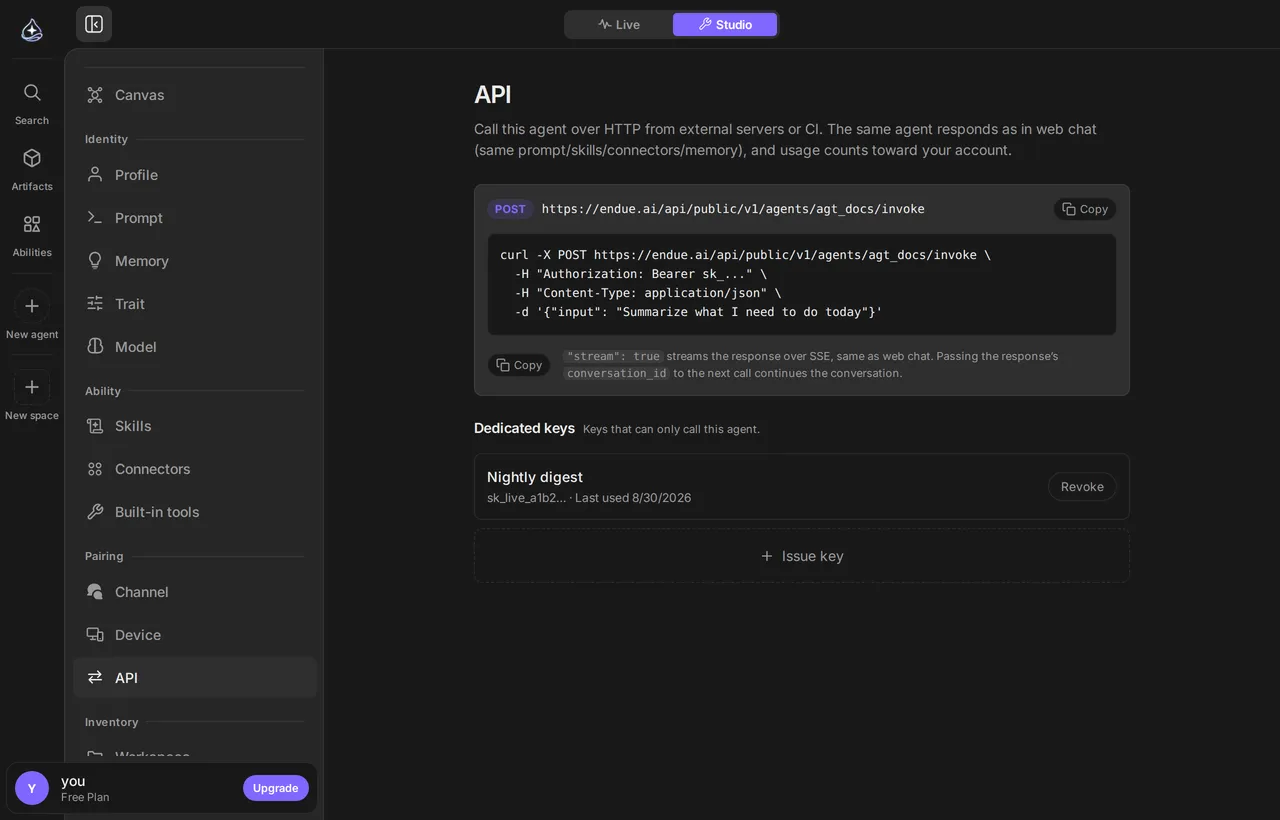
The **API** section issues keys that let something outside Endue call this agent. It is the third way in, beside a [conversation](/docs/work/conversations/) and a [channel](/docs/automate/channels/) — this one is for programs.
## When to use it
[Section titled “When to use it”](#when-to-use-it)
When the caller is code: a script that files a daily summary, a backend that asks an agent to classify something, a job that runs in CI. If the caller is a person, a channel is a better fit — it gives them a thread, questions, and approvals.
## Issue a key
[Section titled “Issue a key”](#issue-a-key)
1. **Open the API section** in [Agent Builder](/docs/build/agent-builder/) and create a key.
2. **Copy it now.** The key is shown once. If you lose it, revoke it and issue another.
3. **Keep it somewhere a program can read and a person cannot** — an environment variable or a secret store, never a repository.
A key created here is **scoped to this agent**: it cannot be used to call your other agents. Account-wide keys, which can, are issued from **Settings → Account** instead. Prefer the narrow one.
[](/docs/_astro/studio-api.BDspvMMe.png)
[Open full size](/docs/_astro/studio-api.BDspvMMe.png)
## Call the agent
[Section titled “Call the agent”](#call-the-agent)
Send the key as `Authorization: Bearer sk_…` (or `X-API-Key`), and post what you want the agent to do:
```http
POST /api/public/v1/agents/{agent_id}/invoke
Authorization: Bearer sk_...
Content-Type: application/json
{ "input": "Summarize yesterday's support tickets" }
```
The response carries the agent’s answer along with a **session id**. Send that id back on the next call and the agent continues in the same context — the same conversation, with its history — instead of starting fresh:
```json
{ "input": "Now group them by product area", "session_id": "..." }
```
Set `"stream": true` to receive the answer as it is produced rather than waiting for the whole run.
A session is a conversation
Sessions are not a separate thing to manage. Each one is a conversation you can open in Endue — under the agent’s API group in the sidebar — to read what the agent was asked and what it answered.
## What an API call does not get
[Section titled “What an API call does not get”](#what-an-api-call-does-not-get)
An API caller is not sitting in front of the conversation, so it is treated as an [unattended run](/docs/automate/routines/#nobody-is-there-to-approve):
* Actions that send outward or delete are **refused**, not queued for someone to approve.
* [Questions](/docs/work/questions/) the agent needs answered have nobody to answer them.
Write the request precisely enough that the agent does not need a decision, and expect drafts rather than sends.
## Limits
[Section titled “Limits”](#limits)
* One run at a time per session. Calling again while a run is in progress on that session is rejected rather than queued.
* Keys are shown once and cannot be recovered — revoke and reissue.
* A key scoped to an agent works only for that agent; the endpoint returns not-found for others.
* Revoking a key takes effect immediately.
## Related
[Section titled “Related”](#related)
[Channels](/docs/automate/channels/)The way in for people rather than programs.
[Approvals](/docs/work/approvals/)Why an API call cannot send email on its own.
[Security and permissions](/docs/account/security/)What a key can reach, and how to withdraw it.
# Agent Builder
> Where you create an agent and tune everything about it — identity, prompt, memory, skills, connectors, built-in tools, channels, and storage.
**Agent Builder** is where an agent is created and everything about it is tuned. Every setting that changes how an agent behaves lives here, grouped into four sections.
## When to use it
[Section titled “When to use it”](#when-to-use-it)
Open Agent Builder when you want to change *what an agent is*, rather than ask it to do something. Creating an agent, rewriting its prompt, giving it a connector, turning a capability off, checking what it remembered — all of that happens here. Day-to-day work happens in a [conversation](/docs/work/conversations/) instead.
## Create an agent
[Section titled “Create an agent”](#create-an-agent)
1. **Start a new agent.**
From your agent list, choose to create a new agent. You are asked for a name and a handle. The handle is short and stable — it is how you address the agent later.
2. **Say what it is for, in one sentence.**
Be specific. *“Summarizes my unread email each morning and flags anything that needs a reply”* produces a far better agent than *“email assistant”*. This sentence is the seed of the [system prompt](/docs/build/system-prompt/).
3. **Open Agent Builder and work down the sections.**
A new agent can already reason, calculate, and read public web pages. Everything else you add deliberately.
## The four sections
[Section titled “The four sections”](#the-four-sections)
Agent Builder is organized by what part of the agent you are changing.
| Section | Contains | Page |
| ------------- | ---------------------------------- | -------------------------------------------------------------------------------------------------------------------- |
| **Identity** | Profile, prompt, memory | [Identity and profile](/docs/build/identity/) · [System prompt](/docs/build/system-prompt/) · [Memory](/docs/capabilities/memory/) |
| **Ability** | Skills, connectors, built-in tools | [Skills](/docs/capabilities/skills/) · [Connectors](/docs/connect/overview/) · [Built-in tools](/docs/capabilities/built-in-tools/) |
| **Pairing** | Channels, devices | [Channels](/docs/automate/channels/) |
| **Inventory** | Workspaces, artifacts | [Artifacts](/docs/capabilities/artifacts/) |
The split is worth internalizing: **Identity** is who the agent is, **Ability** is what it can reach, **Pairing** is where it can be reached from, and **Inventory** is what it has produced.
## The anatomy of an agent
[Section titled “The anatomy of an agent”](#the-anatomy-of-an-agent)
Three things determine how an agent behaves, in roughly this order of impact:
**Its system prompt.** The standing instructions it reads before every conversation. This is the single biggest lever, and the one most people under-use. See [System prompt and revisions](/docs/build/system-prompt/).
**What is bound to it.** An agent can only use the skills and connections you bind to it. Binding is per agent, not per account — connecting Gmail once does not hand your inbox to every agent you own.
**Its model.** Which model runs the loop, and how much reasoning effort it spends. See [Choosing a model](/docs/build/models/).
Narrow beats broad
An agent with one job and three tools outperforms one with a vague purpose and twenty. When you find yourself widening an agent’s prompt to cover a second job, build a second agent instead.
## Limits
[Section titled “Limits”](#limits)
* An agent’s handle is chosen at creation and is not meant to change afterwards.
* Changes to an agent apply to its **next** run. A run already in flight keeps the configuration it started with — including the prompt revision, the model, and the bound tools.
* Agent Builder configures a single agent. There is no bulk edit across agents.
* Deleting an agent does not delete the [artifacts](/docs/capabilities/artifacts/) it produced.
## Related
[Section titled “Related”](#related)
[Identity and profile](/docs/build/identity/)Name, handle, profile, and the character that shapes its tone.
[System prompt and revisions](/docs/build/system-prompt/)The biggest lever you have, and how to change it safely.
[Choosing a model](/docs/build/models/)The model catalog, reasoning effort, and when each matters.
[Testing and iterating](/docs/build/iterating/)Change an agent without breaking one that already works.
# Canvas
> A map of one agent — what is bound to it, drawn as a graph you can click into.
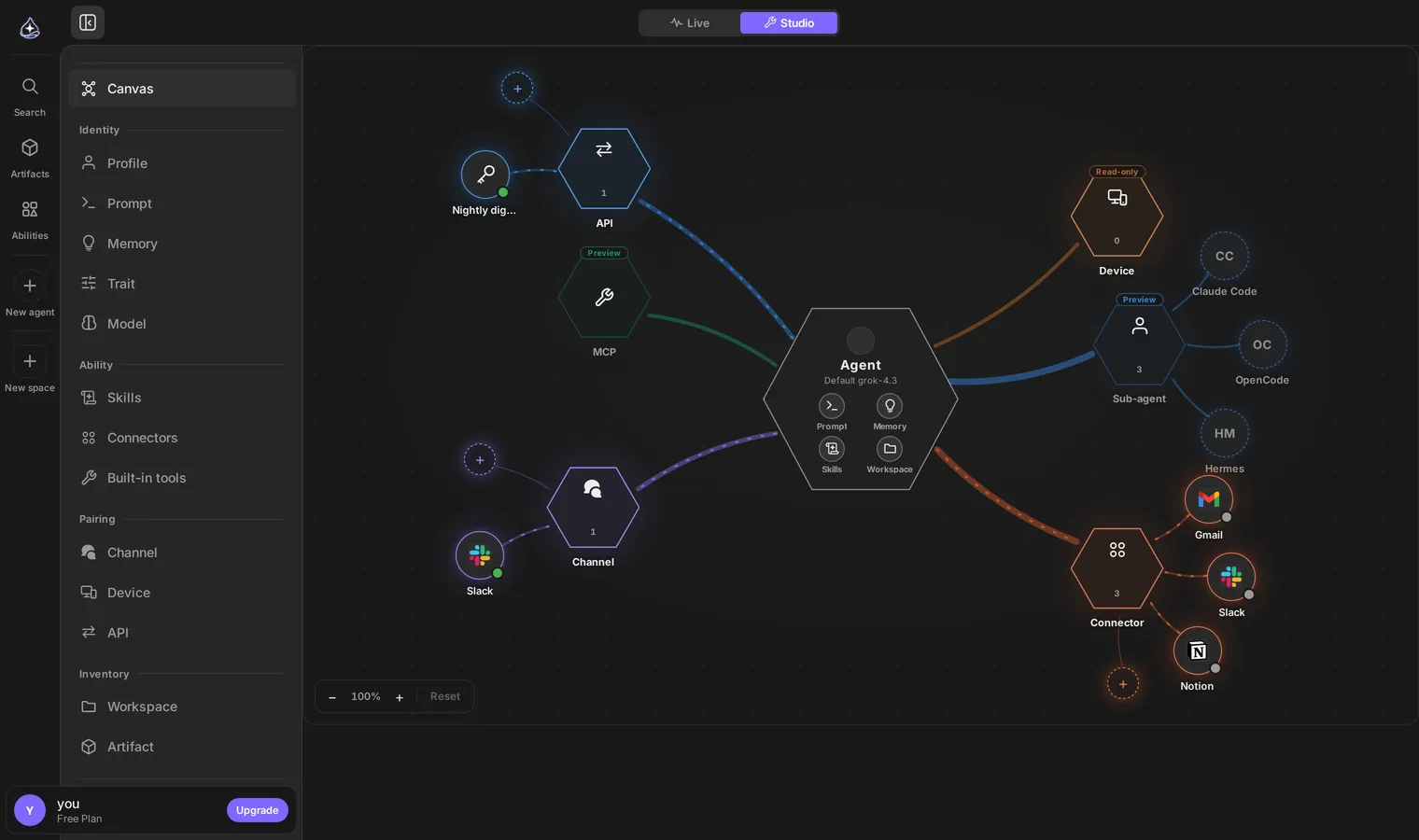
The **canvas** draws an agent and everything attached to it: the skills and connectors it can use, the channels it answers on, the workspace it owns. It is the same configuration as the [Agent Builder](/docs/build/agent-builder/) sections, seen all at once.
[](/docs/_astro/studio-canvas.Bx7olpr0.png)
An axis with nothing on it still appears — the gaps are as visible as the connections.[Open full size](/docs/_astro/studio-canvas.Bx7olpr0.png)
## When to use it
[Section titled “When to use it”](#when-to-use-it)
Open the canvas when you want to know *what this agent actually is* rather than change one setting — before handing it a channel, when a colleague asks what it can reach, or when an agent behaves in a way its prompt does not explain.
Use the sections when you know what you are changing. The canvas is for looking.
## Reading it
[Section titled “Reading it”](#reading-it)
The agent sits in the middle. Around it are the things bound to it, grouped by kind — abilities, pairings, inventory. An axis with nothing on it still appears, so the gaps are as visible as the connections.
Selecting a node opens the same panel the corresponding section uses, so you can go from *“what does this agent have”* to changing it without leaving the map.
Some axes are shown before they are configurable
A few nodes exist to show the shape of the model rather than to be edited yet. If a node opens a read-only panel, that axis is not configurable from here.
## Limits
[Section titled “Limits”](#limits)
* The canvas shows one agent. There is no view across all your agents.
* It reflects configuration, not activity — what the agent *can* reach, not what it used today. For that, see [usage](/docs/account/plans-and-usage/) or the [run](/docs/work/runs/) itself.
* Editing still happens in panels. The canvas is a way in, not a separate editor.
## Related
[Section titled “Related”](#related)
[Agent Builder](/docs/build/agent-builder/)The same configuration, section by section.
[Security and permissions](/docs/account/security/)What being bound actually grants.
# Devices
> Pair your own machine to an agent so it can work with local files and tools, instead of only what lives in the cloud.
A **device** is a computer of yours that an agent can reach. Pairing one is what lets an agent work with files and tools that exist on your machine rather than in a service you connected.
## Device versus workspace
[Section titled “Device versus workspace”](#device-versus-workspace)
Both give an agent somewhere to do work, and they are not interchangeable:
| | [Workspace](/docs/build/workspace/) | Device |
| -------------- | -------------------------------------------------------------- | ------------------------------------------------------ |
| Where it runs | Endue’s infrastructure | Your own machine |
| Who sets it up | Prepared automatically when work needs it | You pair it |
| Good for | Anything self-contained — checking out code, building a report | Files, tools, and networks only your machine can reach |
## Pairing
[Section titled “Pairing”](#pairing)
The Devices section in [Agent Builder](/docs/build/agent-builder/) lists the machines paired to this agent and their state: available, pairing requested, paired, or inactive. Pairing is initiated from the machine — the agent side is the list you see here, and revoking a pairing here cuts the agent off immediately.
Setup docs in progress
Pairing a device needs the desktop app or the CLI, and neither is generally available yet. Install and pairing instructions ship with them — see [Surfaces](/docs/get-started/surfaces/) for what each one does today.
## Limits
[Section titled “Limits”](#limits)
* A paired device is a door into your machine. Pair only machines you control, and revoke pairings you no longer use.
* Work on a device happens where the device is. If it is asleep or offline, the agent cannot reach it.
* Actions that write or execute are subject to the same [approval](/docs/work/approvals/) gate as everywhere else.
* Devices are paired per agent, not per account.
## Related
[Section titled “Related”](#related)
[Surfaces](/docs/get-started/surfaces/)The desktop app and CLI that make a machine pairable.
[Workspace](/docs/build/workspace/)The cloud machine an agent gets without pairing anything.
[Security and permissions](/docs/account/security/)What an agent can and cannot reach.
# Identity and profile
> An agent's name, handle, avatar, profile, and character — what each one changes, and which ones the agent itself can see.
An agent’s **identity** is the part of it you address and recognize: its name, its handle, its avatar, and the character that shapes how it writes.
## When to use it
[Section titled “When to use it”](#when-to-use-it)
Set identity when you create an agent, and revisit it when you have more than a handful of agents and can no longer tell them apart at a glance. Identity is not where you change behavior — that is the [system prompt](/docs/build/system-prompt/).
## What each field does
[Section titled “What each field does”](#what-each-field-does)
| Field | Visible where | Changes what |
| ------------- | ------------------------------------------------ | --------------------------------------------- |
| **Name** | Agent lists, conversation headers, notifications | How you recognize it |
| **Handle** | Addressing the agent, mentions | How you refer to it |
| **Avatar** | Everywhere the agent appears | Recognition at a glance |
| **Profile** | Agent Builder, agent detail | A short description of what this agent is for |
| **Character** | The agent’s own context | Tone and manner of its replies |
## Character versus system prompt
[Section titled “Character versus system prompt”](#character-versus-system-prompt)
These two are often confused, and keeping them separate is what makes both useful.
**Character** is *manner* — concise or expansive, formal or direct, how much it hedges. **System prompt** is *job* — what it does, what it must never do, what a good result looks like.
If you put the job in the character field, you will find yourself unable to change tone without rewriting the job. If you put tone rules in the prompt, they compete for attention with the instructions that matter.
The agent sees its own identity
Name, handle, and character are part of what the agent reads at the start of a run. An agent named “Inbox Triage” with a terse character behaves differently from the same prompt under a different identity — usually mildly, occasionally more than you expect.
## Avatars
[Section titled “Avatars”](#avatars)
An agent’s avatar appears in every list, header, and notification that mentions it. Uploading one is the cheapest way to make a workspace with several agents navigable. An agent without an uploaded avatar falls back to a generated one.
## Limits
[Section titled “Limits”](#limits)
* The handle is chosen at creation and is intended to be stable — other things reference it.
* Identity fields do not grant the agent anything. An agent named “Email Assistant” has no access to email until a [connector](/docs/connect/overview/) is bound to it.
* Character shapes tone, not capability. It cannot make the agent do something its prompt and tools do not allow.
## Related
[Section titled “Related”](#related)
[System prompt and revisions](/docs/build/system-prompt/)Where the agent's actual job is defined.
[Agent Builder](/docs/build/agent-builder/)The four sections, and what belongs in each.
# Testing and iterating
> Change an agent that already works without breaking it — what to change one at a time, how to tell whether it helped, and how to get back.
An agent is tuned by iteration: change one thing, run the same task, compare. Endue keeps prompt [revisions](/docs/build/system-prompt/#revisions-and-rollback) so the “get back” step is always available.
## When to use it
[Section titled “When to use it”](#when-to-use-it)
Whenever an agent is nearly right. The failure mode this page exists to prevent is the common one: three changes at once, the agent gets better in one way and worse in another, and nothing can be attributed to anything.
## A loop that works
[Section titled “A loop that works”](#a-loop-that-works)
1. **Keep a task you re-run.** Two or three real requests you have asked before, whose good answer you can recognize immediately. This is your test set. Without one, “better” is a feeling.
2. **Change one thing.** The prompt, or the model, or a binding — not all three.
3. **Run the same task in a new conversation.** A new [conversation](/docs/work/conversations/) matters: an existing thread carries history that changes the answer independently of your edit.
4. **Compare against what you saw before.** Look at the tool calls, not only the final text — that is where a prompt change usually shows up first.
5. **Keep it or roll back.** If it is worse, restore the previous prompt revision and try a different change.
## What to change, in order
[Section titled “What to change, in order”](#what-to-change-in-order)
Work down this list. The earlier items move results more, per unit of effort.
| Try | When the symptom is |
| --------------------------------------------------------------- | -------------------------------------------------------------------------------- |
| Sharpen “what a good result looks like” in the prompt | The answer is right but not usable — wrong format, wrong depth, buries the point |
| Add a hard rule | It repeats a specific mistake |
| Bind a connector or skill | It guesses at something it should look up |
| Turn off a [built-in tool group](/docs/capabilities/built-in-tools/) | It reaches for a capability that is noise for this agent |
| Raise [reasoning effort](/docs/build/models/#reasoning-effort) | It skips steps in long tasks |
| Change the model | Everything above is right and it still cannot follow the task |
| Split into two agents | The prompt has grown to cover two unrelated jobs |
## Reading a run to diagnose it
[Section titled “Reading a run to diagnose it”](#reading-a-run-to-diagnose-it)
Most “the agent is bad” problems are visible in the [run](/docs/work/runs/) itself.
* **It called no tools.** It thinks it should answer from memory. Usually a prompt problem, sometimes a missing binding.
* **It called the right tool with bad arguments.** It is missing context — say it in the prompt, or store it in [memory](/docs/capabilities/memory/).
* **It called tools in a loop without converging.** The task is underspecified, or the effort setting is too low for its length.
* **It asked you something it should know.** That fact belongs in the prompt or in memory.
Steering is a diagnostic, not just a fix
If [steering](/docs/work/steering/) a run with one sentence reliably rescues it, that sentence belongs in the system prompt. A correction you find yourself sending repeatedly is a prompt bug you have not fixed yet.
## Limits
[Section titled “Limits”](#limits)
* There is no built-in evaluation harness or automated scoring. Comparison is by hand, against tasks you choose.
* There is no draft mode: an agent has one live configuration, and changes take effect on its next run. To try something risky without disturbing an agent you rely on, build a copy and experiment on that.
* Revision history covers the system prompt. Other settings — model, bindings, tool groups — are not versioned, so note what you changed.
## Related
[Section titled “Related”](#related)
[System prompt and revisions](/docs/build/system-prompt/)The lever you will pull most, and how to undo it.
[Runs](/docs/work/runs/)Reading what the agent actually did, step by step.
[Steering a run](/docs/work/steering/)Correcting a run in flight — and what that tells you.
# Choosing a model
> Pick the model an agent runs on, set how much reasoning effort it spends, and override both for a single message.
Every [run](/docs/work/runs/) is driven by a model. Endue offers a catalog from several providers, and you choose which one an agent uses — as its default, or for one message.
## When to use it
[Section titled “When to use it”](#when-to-use-it)
Change the model when the agent’s *reasoning* is the problem: it misses steps in a long task, or it is slow and expensive for work that is genuinely simple. If the agent is doing the wrong job rather than doing the job badly, fix the [system prompt](/docs/build/system-prompt/) first — a bigger model follows a vague instruction just as faithfully.
## The catalog
[Section titled “The catalog”](#the-catalog)
The model picker lists what is available, with the details that actually decide the choice: context window, input and output price per million tokens, what the model accepts (text, images, files), and whether it supports tool calling.
**Tool calling is the one to check.** An Endue agent works by calling tools. A model that does not support tool calling can answer from what it already knows, but it cannot search your email, write an artifact, or use a connector. Those models are labeled in the picker.
## Reasoning effort
[Section titled “Reasoning effort”](#reasoning-effort)
Some models expose a **reasoning effort** setting — how much thinking they do before answering. Higher effort costs more tokens and takes longer; it pays off on multi-step work where a wrong early decision wastes the rest of the run.
A rough guide:
| Work | Effort |
| ---------------------------------------------------------------------------- | ------ |
| Reformatting, extraction, classification, short answers | Low |
| Everyday multi-step tasks with a handful of tool calls | Medium |
| Long chains where an early mistake compounds — research, planning, debugging | High |
[](/docs/_astro/studio-model.iwYKzThY.png)
[Open full size](/docs/_astro/studio-model.iwYKzThY.png)
## Per-agent, per-message, per-routine
[Section titled “Per-agent, per-message, per-routine”](#per-agent-per-message-per-routine)
Three places set a model, each overriding the one above it:
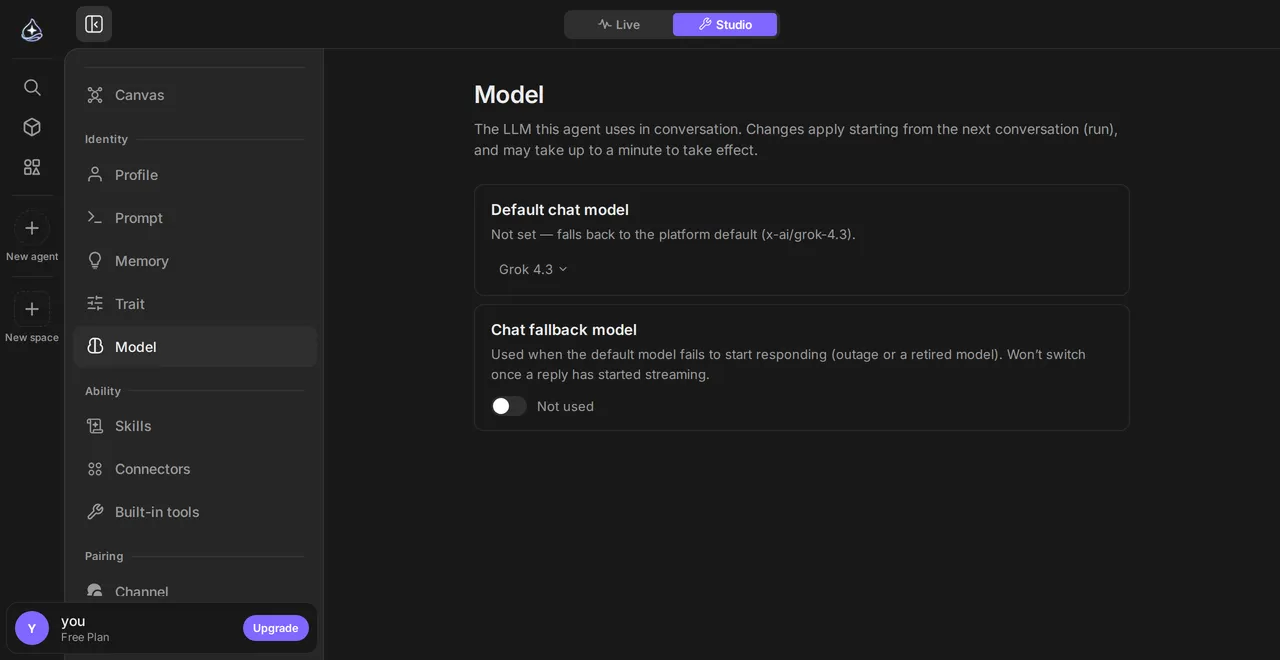
* **The agent’s default**, in [Agent Builder](/docs/build/agent-builder/) — what it uses unless told otherwise.
* **A single message**, from the composer — useful for one hard question inside a cheap agent’s conversation.
* **A [routine](/docs/automate/routines/)**, which can pin its own model so a scheduled job does not change cost when you retune the agent.
Cheaper agent, occasional escalation
Setting a fast model as the agent default and reaching for a stronger one on the few messages that need it usually costs less than running everything on the strongest model — and the agent feels quicker for the routine 90%.
## Cost
[Section titled “Cost”](#cost)
Model usage is what consumes your plan’s allowance, and prices differ by more than an order of magnitude across the catalog. The picker shows input and output price for each model. See [Plans and usage](/docs/account/plans-and-usage/) for how usage is measured and where to watch it, and [Bring your own key](/docs/account/bring-your-own-key/) if you want to pay the provider directly instead.
## Limits
[Section titled “Limits”](#limits)
* Not every model supports every capability. Tool calling, image input, and reasoning effort vary by model, and the picker is the source of truth.
* Changing the model does not change the agent’s prompt, memory, or bindings.
* A run in flight keeps the model it started with. Switching models applies to the next run.
* Context windows differ. A very long conversation that fits one model may not fit another.
## Related
[Section titled “Related”](#related)
[Plans and usage](/docs/account/plans-and-usage/)What consumes usage, and where to see how much you have used.
[Bring your own key](/docs/account/bring-your-own-key/)Use your own model credentials instead of Endue's.
[How Endue works](/docs/get-started/how-it-works/)The loop the model is driving, and why the choice matters.
# System prompt and revisions
> Write the standing instructions an agent reads before every conversation, keep every version, and roll back when a change makes the agent worse.
The **system prompt** is the standing instruction an agent reads before every conversation: what it does, how it should decide, what it must never do. Every version you save is kept, so changing it is reversible.
## When to use it
[Section titled “When to use it”](#when-to-use-it)
Reach for the prompt when the agent’s *behavior* is wrong — it does the wrong thing, in the wrong format, or asks you things it should already know. Reach for a [connector](/docs/connect/overview/) or a [skill](/docs/capabilities/skills/) when it lacks a *capability*. Prompting cannot substitute for access.
## Write one
[Section titled “Write one”](#write-one)
1. **Open the prompt section in [Agent Builder](/docs/build/agent-builder/).**
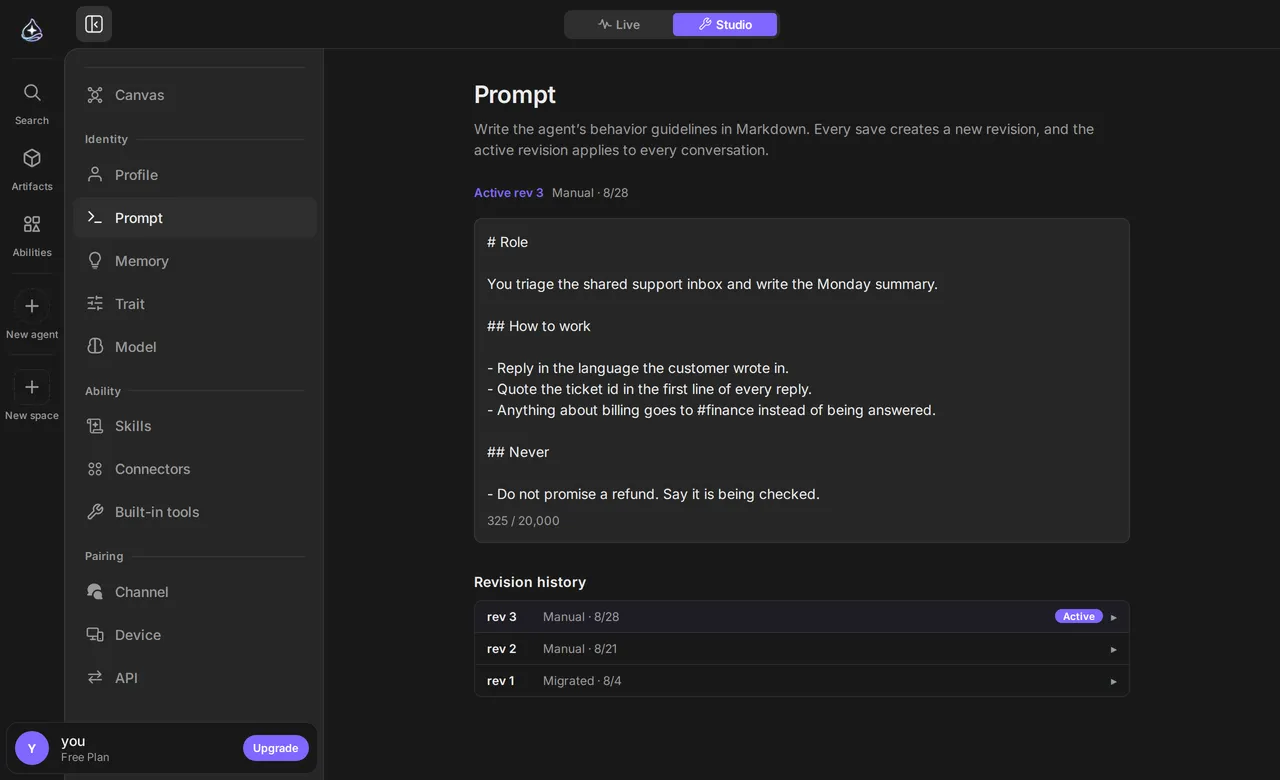
You see the current text and the history of previous revisions.
2. **State the job in one paragraph.**
Who the agent works for, what it is responsible for, and what falls outside that. An agent that knows its boundaries asks fewer pointless questions.
3. **Say what a good result looks like.**
This is the part most prompts skip, and the part that changes results most. The agent chooses its own steps; what it cannot guess is your standard for “done”.
*“Summarize my unread email”* leaves everything to chance. *“Summarize my unread email, grouped by sender; for anything asking me a direct question, quote the question verbatim so I can answer without opening it”* does not.
4. **List the hard rules.**
Things that must always or never happen — never email anyone outside the company, always cite the source document, never guess at a number.
5. **Save it as a new revision.**
The previous text is not overwritten; it becomes a revision you can return to.
[](/docs/_astro/studio-prompt.pjPH7ESY.png)
[Open full size](/docs/_astro/studio-prompt.pjPH7ESY.png)
## Revisions and rollback
[Section titled “Revisions and rollback”](#revisions-and-rollback)
Every save creates a revision. The history shows what the prompt was at each point, and you can restore an earlier one.
This is what makes prompt iteration safe rather than a gamble. Change something, use the agent for a day, and if the change made it worse, go back to the revision that worked — you do not have to remember what the old text said.
A run uses the revision it started with
Restoring a revision affects the agent’s next run. A run already in flight finishes under the prompt it began with, which is why an agent can appear to ignore an edit you just made.
## What belongs where
[Section titled “What belongs where”](#what-belongs-where)
| Put it in | When |
| ------------------------------------ | ---------------------------------------------------------------------------------- |
| **System prompt** | It applies to every conversation — your role, standing rules, output format |
| **A message** | It applies to this task only |
| **[Character](/docs/build/identity/)** | It is about tone, not about the job |
| **[Memory](/docs/capabilities/memory/)** | It is a fact the agent should learn once and reuse — a preference, a name, a habit |
| **A [skill](/docs/capabilities/skills/)** | It is a repeatable procedure with steps, not a standing instruction |
A prompt that has grown to cover four unrelated jobs is a sign you need a second agent, not a longer prompt.
## Limits
[Section titled “Limits”](#limits)
* A prompt cannot grant access. If the agent needs your calendar, it needs a bound connection — writing “you have access to my calendar” changes nothing.
* Restoring a revision replaces the whole prompt. There is no merge between revisions.
* The prompt is per agent. Two agents that should share standing rules need the text in both.
## Related
[Section titled “Related”](#related)
[Testing and iterating](/docs/build/iterating/)How to tell whether a prompt change actually helped.
[Memory](/docs/capabilities/memory/)Facts the agent learns once instead of being told every time.
[Skills](/docs/capabilities/skills/)Repeatable procedures that do not belong in a prompt.
# Traits
> Switches that change how the agent's loop behaves — whether its character reaches the model, and whether it tidies its own memory on a schedule.
A **trait** turns one behavior of the agent on or off. Unlike the [system prompt](/docs/build/system-prompt/), which is text you write, a trait is a switch: the setting stays where it already lives, and the trait decides whether it is used.
## The traits
[Section titled “The traits”](#the-traits)
| Trait | What turning it on does |
| ----------------- | ------------------------------------------------------------------------------------------------------------------------------------------------------------ |
| **Personality** | The character you set in the agent’s [profile](/docs/build/identity/) is included in what the model reads. With it off, the agent works from its prompt alone. |
| **Self-evolving** | The agent reviews and tidies its own [memory](/docs/capabilities/memory/) on a schedule, as a [routine](/docs/automate/routines/) you can see and edit like any other. |
[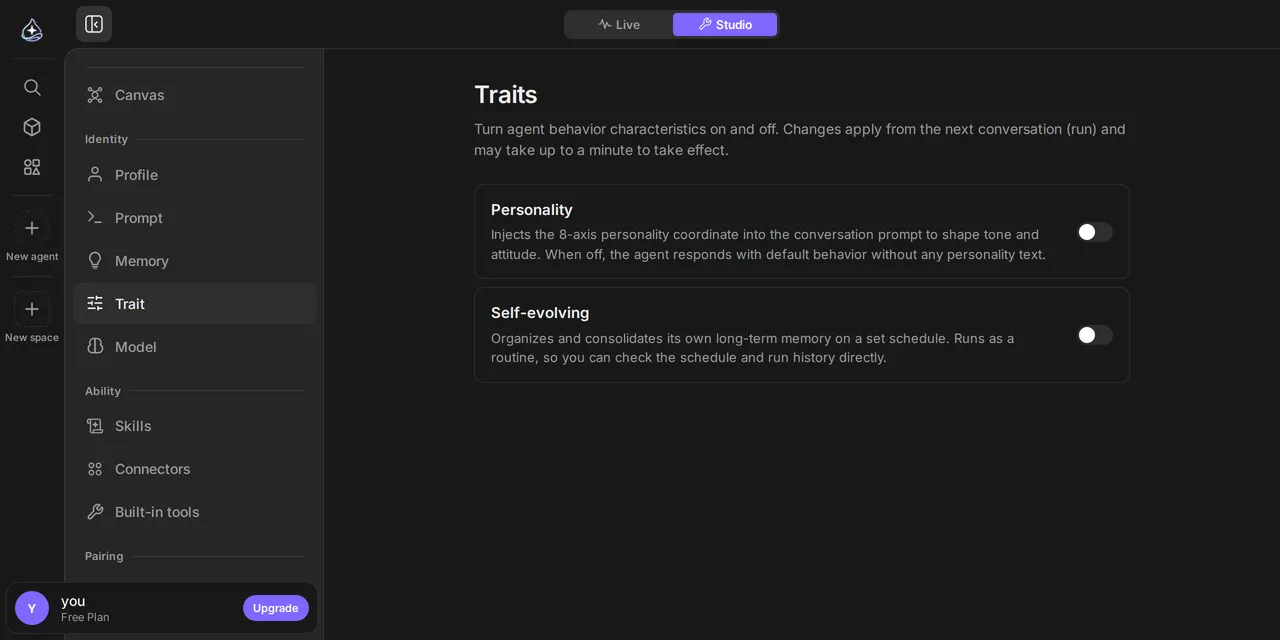](/docs/_astro/studio-trait.CVqH9Mlu.png)
[Open full size](/docs/_astro/studio-trait.CVqH9Mlu.png)
## When to use them
[Section titled “When to use them”](#when-to-use-them)
**Personality** is worth turning on when tone matters — an agent that talks to customers, or one whose replies you read all day. Leave it off when you want the agent to be plain and predictable, or when you are [tuning a prompt](/docs/build/iterating/) and want one fewer variable.
**Self-evolving** earns its place on an agent that has been running for weeks and has accumulated memories it no longer needs. On a new agent there is nothing to tidy.
Turning a trait off keeps its settings
Off is not erased. The character stays on the profile and the routine stays in the routine list — the trait only stops using them. Turning it back on restores the previous behavior.
## Limits
[Section titled “Limits”](#limits)
* Traits are per agent.
* The personality trait does not create a personality; it carries the one already on the profile. Change the character in [Identity](/docs/build/identity/).
* Self-evolving works through a normal routine, so it is subject to the same rules — including that an unattended run cannot ask you anything.
* Changes apply to the agent’s next [run](/docs/work/runs/).
## Related
[Section titled “Related”](#related)
[Identity and profile](/docs/build/identity/)Where the character the personality trait carries is set.
[Memory](/docs/capabilities/memory/)What the self-evolving trait tidies.
[The context window](/docs/work/context-window/)Traits are part of what the model reads on every step.
# Workspace
> A private machine an agent can keep files on and run commands in — provisioned when the work needs one, and gated by approval for anything that writes.
A **workspace** is a sandbox that belongs to one agent: a filesystem it can read and write, and a shell it can run commands in. It is how an agent does work that needs somewhere to put things — checking out code, generating a report from data, keeping a scratch directory between conversations.
## When you get one
[Section titled “When you get one”](#when-you-get-one)
You do not create it up front. Ask an agent for work that needs a machine and it prepares one, telling you in the conversation while it does. Preparation takes a moment the first time; after that the same workspace is there for the next conversation.
The chat shows the preparation as its own step, so a slow first run is legible rather than mysterious.
## What the agent can do in it
[Section titled “What the agent can do in it”](#what-the-agent-can-do-in-it)
Read files and directories, write and move them, and run commands.
Writing and running always ask
Reading is free. Everything that changes the workspace — writing, moving, copying, deleting, running or stopping a command — stops for your [approval](/docs/work/approvals/) first, with the exact operation shown. There is no setting that turns this off, and an unattended run refuses those operations rather than waiting.
## Looking inside
[Section titled “Looking inside”](#looking-inside)
The Workspace section in [Agent Builder](/docs/build/agent-builder/) shows what is in there: the file tree, the contents of a file, and the processes currently running.
It is **read-only, deliberately**. The only way to change a workspace is to ask the agent and approve what it proposes — a browser that could also write would be a way around the approval gate.
The view does not refresh by itself, because the thing changing the files is the agent, not you. Refresh when you want the current state.
[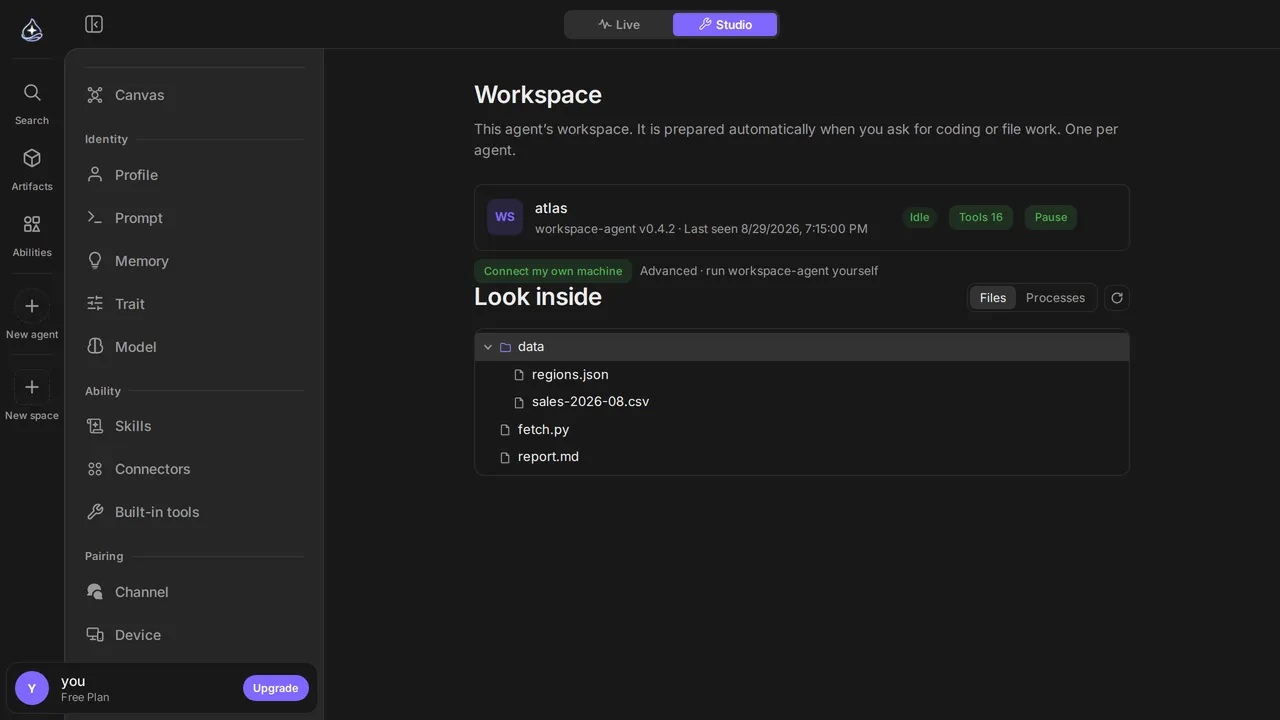](/docs/_astro/studio-workspace.Dxsr2nUX.png)
The tree is read-only. Anything that writes goes through approval in the conversation.[Open full size](/docs/_astro/studio-workspace.Dxsr2nUX.png)
## Limits
[Section titled “Limits”](#limits)
* One workspace per agent.
* It is a machine in Endue’s infrastructure, not your computer. For work on your own files, see [devices](/docs/build/devices/) and the desktop app’s local runtime.
* If the workspace is offline the panel says so; ask the agent for something that needs it and it will be brought back.
* The browser lists and reads. It does not upload, edit, or delete.
## Related
[Section titled “Related”](#related)
[Approvals](/docs/work/approvals/)The gate every write and command goes through.
[Artifacts](/docs/capabilities/artifacts/)Where results belong once they are worth keeping.
[Devices](/docs/build/devices/)The other kind of machine — your own.
# Artifacts
> The documents, reports, and files an agent produces — where they live, how to read and export them, and how link sharing works.
An **artifact** is something an agent produced that is worth keeping — a report, a document, a dataset, a diagram. Instead of being buried in a transcript, it gets its own page.
## When you get one
[Section titled “When you get one”](#when-you-get-one)
The agent decides. Ask for something substantial — *“write up the findings”*, *“produce the weekly summary”* — and it saves the result as an artifact and links it in the conversation. You can also ask directly: *“save that as an artifact”*.
Short answers stay in the conversation, which is the right default. An artifact is for output you will come back to.
## Working with them
[Section titled “Working with them”](#working-with-them)
**In the conversation**, an artifact appears as a card you can open without leaving the thread.
**On its own page**, you get the full content, a preview for the formats that support one, and export. The agent can read its own artifacts back later, which is what makes a chain of work possible — draft in one conversation, revise in the next.
**In the agent’s Inventory**, every artifact it has produced is listed. Pin the ones you return to so they stay at the top.
## From artifacts to an app
[Section titled “From artifacts to an app”](#from-artifacts-to-an-app)
When an agent has produced a set of files that work together — a page, a small tool, a dashboard — you can promote them into an **app**. An app has its own page, opens as a working thing rather than a document, and can be shared by link the same way an artifact is.
Promotion is a **move**: the artifacts become the app’s first version and the original entries go away. That keeps one copy of the truth, so the same result does not appear twice in your lists. The originals are removed only after the app is saved — if saving fails, nothing is lost.
An app opens in one of two modes:
* **Viewer** — the result, and nothing else around it. This is what a link recipient sees.
* **Canvas** — the app beside the conversation, so you can ask for a change and watch it land.
## Sharing by link
[Section titled “Sharing by link”](#sharing-by-link)
An artifact is **private to you** by default. Turning on link sharing produces a URL that opens that one artifact.
What a link grants:
| Grants | Does not grant |
| ---------------------------- | --------------------------------------- |
| Read access to this artifact | Access to any other artifact |
| Nothing else | The conversation it came from |
| | Your agent, its memory, or your account |
Anyone with the link can open it, so treat it as public. Turning sharing off makes the link stop working — an artifact that is not shared is not found by URL at all, whether or not someone guessed it.
Check the contents before you share
An artifact an agent wrote from your email or documents may quote them. Read it before you turn on the link.
## Limits
[Section titled “Limits”](#limits)
* **No version history.** Updating an artifact replaces its contents. If you need the previous state, export it first or ask the agent to save a separate artifact.
* Artifacts belong to the agent that produced them and to you. Another agent does not read them unless you point it at one.
* Link sharing is read-only, and it is one link per artifact — there is no per-person access.
* Deleting an agent does not delete its artifacts.
## Related
[Section titled “Related”](#related)
[Projects](/docs/capabilities/projects/)Grouping the work an artifact belongs to.
[Routines](/docs/automate/routines/)Scheduled work whose output is usually an artifact.
[Security and permissions](/docs/account/security/)What is private, what is shared, and what an agent can reach.
# Built-in tools
> What every agent can do with no setup — and which of those capabilities you can switch off per agent.
**Built-in tools** are the capabilities an agent has before you connect anything. They are grouped, and each group can be switched off for an individual agent.
## When to use it
[Section titled “When to use it”](#when-to-use-it)
You rarely turn these *on* — they are on by default. You turn them *off* to narrow an agent. An agent that should only summarize what you paste into it does not need to fetch web pages; an agent that should never schedule anything does not need routine tools.
## The groups
[Section titled “The groups”](#the-groups)
| Group | What the agent can do |
| ----------------- | ------------------------------------------------------------------------------------ |
| **Artifacts** | Save, list, read, update, and delete [artifacts](/docs/capabilities/artifacts/) |
| **Routines** | Create and manage [routines](/docs/automate/routines/) from inside a conversation |
| **Memory** | Remember, recall, update, and forget — see [Memory](/docs/capabilities/memory/) |
| **Projects** | Read and update the [project](/docs/capabilities/projects/) a conversation belongs to |
| **Skill tools** | Look through installed [skills](/docs/capabilities/skills/), use one, or author a new one |
| **Visualization** | Draw a chart or widget inline in the conversation |
| **Web fetch** | Read the contents of a URL |
| **Utility** | Precise arithmetic and the current time |
Turning off **Memory** also stops the agent’s memory index being loaded at the start of a conversation — the group is the whole capability, not just the tools.
[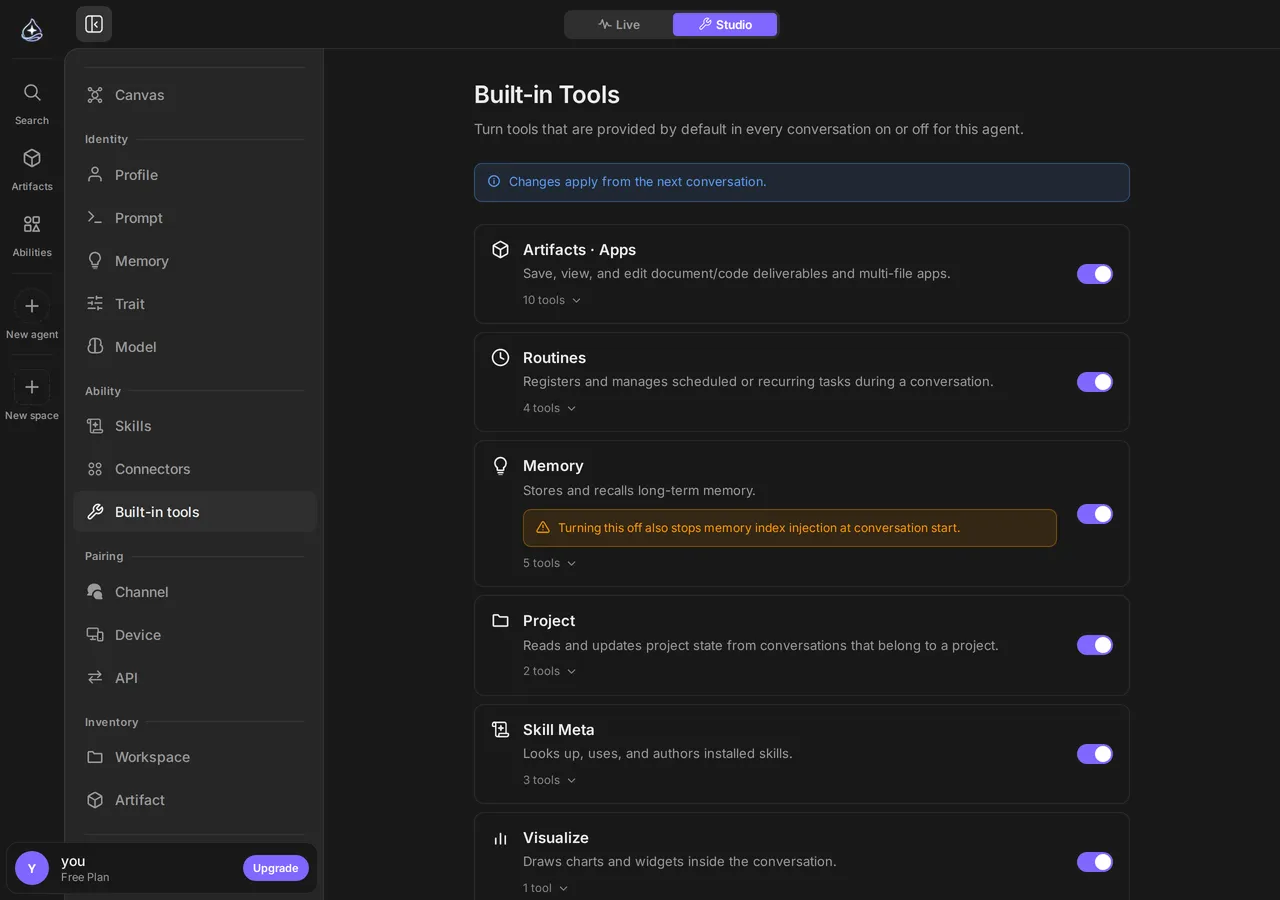](/docs/_astro/studio-tools.CbItWCe4.png)
[Open full size](/docs/_astro/studio-tools.CbItWCe4.png)
## Always on
[Section titled “Always on”](#always-on)
A few tools are infrastructure for the conversation itself and cannot be turned off:
* Asking you a [question](/docs/work/questions/) — options or free text.
* Requesting a [skill](/docs/capabilities/skills/#when-an-agent-asks-for-a-skill) it has not been given.
An agent that could not ask you anything would guess instead, which is worse in every case.
Turning tools off is a tuning technique
Every advertised tool is one more thing the model weighs on each step. Removing groups an agent has no business using measurably sharpens its choices — this is one of the cheaper fixes on the [iteration list](/docs/build/iterating/#what-to-change-in-order).
## Limits
[Section titled “Limits”](#limits)
* Built-in tools are per agent. Turning a group off for one agent does not affect others.
* Turning a group off applies to the agent’s next [run](/docs/work/runs/).
* Built-in tools do not reach your accounts. Anything touching Gmail, Slack, Notion, or another service comes from a [connector](/docs/connect/overview/), not from here.
* Web fetch reads pages that are publicly reachable. It is not a browser and does not sign in anywhere.
## Related
[Section titled “Related”](#related)
[Skills](/docs/capabilities/skills/)Capabilities you add, rather than ones that ship on.
[Connectors overview](/docs/connect/overview/)Tools that reach your actual accounts.
[Testing and iterating](/docs/build/iterating/)Where narrowing an agent's tools fits in tuning it.
# Memory
> What an agent keeps between conversations, how it decides, and how to inspect, correct, or delete what it stored.
**Memory** is what an agent carries between [conversations](/docs/work/conversations/) — facts about you, your preferences, how you like work done. It is stored deliberately and you can read every entry.
## When to use it
[Section titled “When to use it”](#when-to-use-it)
Memory is for facts with a long shelf life that you should not have to repeat: which timezone you work in, who your team is, that you want numbers rounded, that “the report” means the one in a specific folder.
It is not a filing cabinet. Content belongs in an [artifact](/docs/capabilities/artifacts/); background for one body of work belongs in a [project](/docs/capabilities/projects/).
## How an agent uses it
[Section titled “How an agent uses it”](#how-an-agent-uses-it)
The agent decides what is worth keeping and writes it down — often after you correct it, or state a preference. At the start of a conversation it loads an index of what it knows, and pulls in the entries relevant to the task rather than everything it has ever stored.
You can also just tell it: *“remember that I never want Friday meetings”* is a normal instruction and it will store it.
## Inspecting and correcting
[Section titled “Inspecting and correcting”](#inspecting-and-correcting)
Memory is listed in [Agent Builder](/docs/build/agent-builder/), under the agent’s Identity section. Every entry is readable, and you can delete anything that should not have been kept.
Do check it occasionally. Agents write down what they infer, and an inference stated as fact — *“prefers short replies”* after one impatient message — will quietly shape answers for weeks.
Memory is per agent
Each agent remembers separately. Teaching one agent your preferences does not teach the others. Anything every agent should know is better placed in each agent’s [system prompt](/docs/build/system-prompt/).
[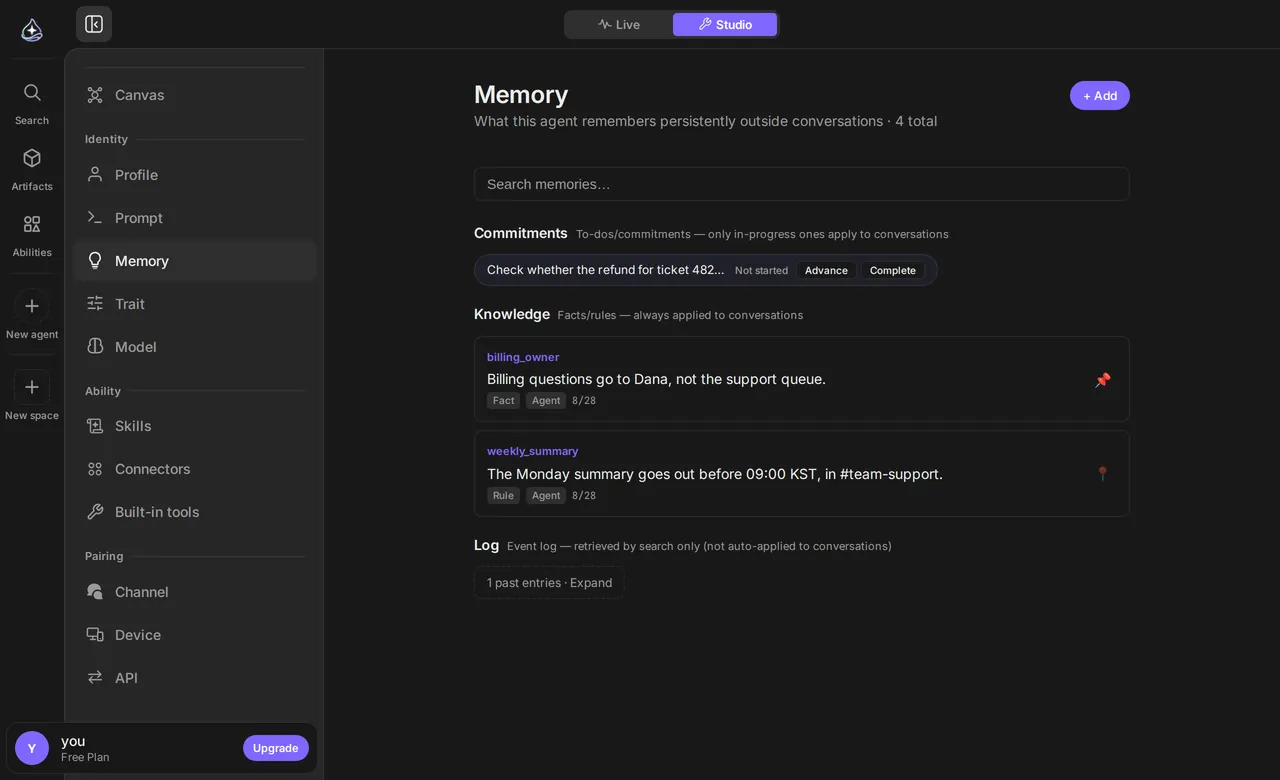](/docs/_astro/studio-memory.B5hlGp_W.png)
[Open full size](/docs/_astro/studio-memory.B5hlGp_W.png)
## Turning it off
[Section titled “Turning it off”](#turning-it-off)
Memory is a [built-in tool group](/docs/capabilities/built-in-tools/). Switching it off for an agent stops it storing and recalling, and stops the memory index being loaded at the start of a conversation. Existing entries are kept; the agent stops using them.
This is the right setting for an agent that handles other people’s data, or one you want stateless and predictable.
## Limits
[Section titled “Limits”](#limits)
* Memory is per agent, not per account.
* The agent decides what to store; you cannot pre-write a list of memories, but you can tell it what to remember and delete what it got wrong.
* Deleting an entry stops it being recalled in future runs. It does not edit conversations where it was already used.
* Memory is not searchable content storage. Large documents belong in artifacts.
## Related
[Section titled “Related”](#related)
[Projects](/docs/capabilities/projects/)Shared context for one body of work, rather than for the agent.
[System prompt](/docs/build/system-prompt/)Standing rules that should never be forgotten or inferred.
[Built-in tools](/docs/capabilities/built-in-tools/)Where memory is switched on and off.
# Projects
> Group conversations around one body of work and give an agent standing context it reads on every run.
A **project** groups the [conversations](/docs/work/conversations/) that belong to the same body of work, and carries context every conversation inside it can read.
## When to use it
[Section titled “When to use it”](#when-to-use-it)
Use a project when you notice yourself re-explaining the same background in thread after thread — the client, the codebase, the launch, the quarter. The project holds that background once.
| Put it in | When |
| ------------------------------------------ | -------------------------------------------- |
| The [system prompt](/docs/build/system-prompt/) | It is true of everything the agent ever does |
| A project | It is true of this body of work |
| [Memory](/docs/capabilities/memory/) | It is true of you, across all work |
| A message | It is true of this one task |
## What a project gives an agent
[Section titled “What a project gives an agent”](#what-a-project-gives-an-agent)
A conversation inside a project starts with the project’s context available. The agent can also read the project’s current state and update it as work progresses — so a status the agent maintains stays current without you transcribing it.
That makes a project useful as a shared working record: what this work is, where it stands, what was decided.
## Working in one
[Section titled “Working in one”](#working-in-one)
Open the project and start a conversation from it, and that conversation belongs to the project. The project page lists its conversations, so returning to a body of work does not mean hunting through a global recency list.
A project is not a permission boundary
Putting a conversation in a project changes what the agent *reads*, not what it can *reach*. Access still comes from the [connections and skills](/docs/connect/overview/) bound to the agent.
## Limits
[Section titled “Limits”](#limits)
* A conversation belongs to one project.
* Project context is available to conversations in that project — it is not shared with the agent’s other threads.
* Projects group work; they do not grant access, and they are not a place to store documents. Output belongs in [artifacts](/docs/capabilities/artifacts/).
## Related
[Section titled “Related”](#related)
[Conversations](/docs/work/conversations/)The threads a project groups.
[Artifacts](/docs/capabilities/artifacts/)Where the output of a project's work lands.
[Memory](/docs/capabilities/memory/)Context that follows you rather than the work.
# Skills
> Package a repeatable job once, bind it to an agent, and let an agent request a skill it does not have.
A **skill** packages a repeatable job — a procedure, a checklist, a set of steps — so you do not have to re-explain it every time. Bind a skill to an agent and it becomes part of what that agent can do.
## When to use it
[Section titled “When to use it”](#when-to-use-it)
Use a skill when the *how* is stable and worth reusing: a weekly report with a fixed structure, a triage procedure with rules, a research method you want followed the same way every time.
| Put it in | When |
| ------------------------------------------ | ---------------------------------------------------- |
| The [system prompt](/docs/build/system-prompt/) | It applies to everything the agent does |
| A skill | It is one specific job with steps, used occasionally |
| A [routine](/docs/automate/routines/) | The job should also happen on a schedule |
## Binding
[Section titled “Binding”](#binding)
A skill is bound to specific agents, like a [connection](/docs/connect/overview/). Installing or creating a skill does not hand it to every agent you own — you decide which agents get it.
Binding is what keeps an agent predictable. An agent offered twenty skills spends its judgment choosing between them; an agent with three uses them well.
## When an agent asks for a skill
[Section titled “When an agent asks for a skill”](#when-an-agent-asks-for-a-skill)
An agent that would benefit from a skill it has not been given can **request** it rather than failing. The [run](/docs/work/runs/) pauses, and the conversation shows what it wants and why.
Grant it and the skill is bound and the run continues with it available. Decline and the agent carries on without it — usually by doing the job the long way.
Granting is a real binding
Approving a request binds the skill to that agent from then on, not just for the current run. If it was a one-off, unbind it afterwards in [Agent Builder](/docs/build/agent-builder/).
## Finding and creating skills
[Section titled “Finding and creating skills”](#finding-and-creating-skills)
Agents can look through the skills available to them and pick a relevant one for the task at hand, rather than needing you to name it. They can also author a new skill from work you have just done together — useful when you have walked an agent through a procedure once and want it kept.
Skills you create are private to your account unless you publish them.
## Limits
[Section titled “Limits”](#limits)
* A skill is not access. A skill that reads your email still needs an email [connection](/docs/connect/overview/) bound to the same agent.
* Skills are bound per agent. There is no account-wide “all agents get this”.
* Skill steps that call a connector are subject to the same [approval](/docs/work/approvals/) gate as any other action.
## Related
[Section titled “Related”](#related)
[Built-in tools](/docs/capabilities/built-in-tools/)What every agent can do before you bind anything.
[Connectors overview](/docs/connect/overview/)Giving an agent access to a real service.
[Routines](/docs/automate/routines/)Running a packaged job on a schedule.
# Available connectors
> Every service Endue connects to today, what an agent can do with each one, and how you authorize it.
Endue connects to **34 services**. This page is the catalog: what each one lets an agent do, and how you authorize it.
The app is the authority
Connectors are added most weeks. The catalog in the app — and the public [connector directory](/connectors) — is always current; this page is a hand-maintained copy that can lag by a release.
[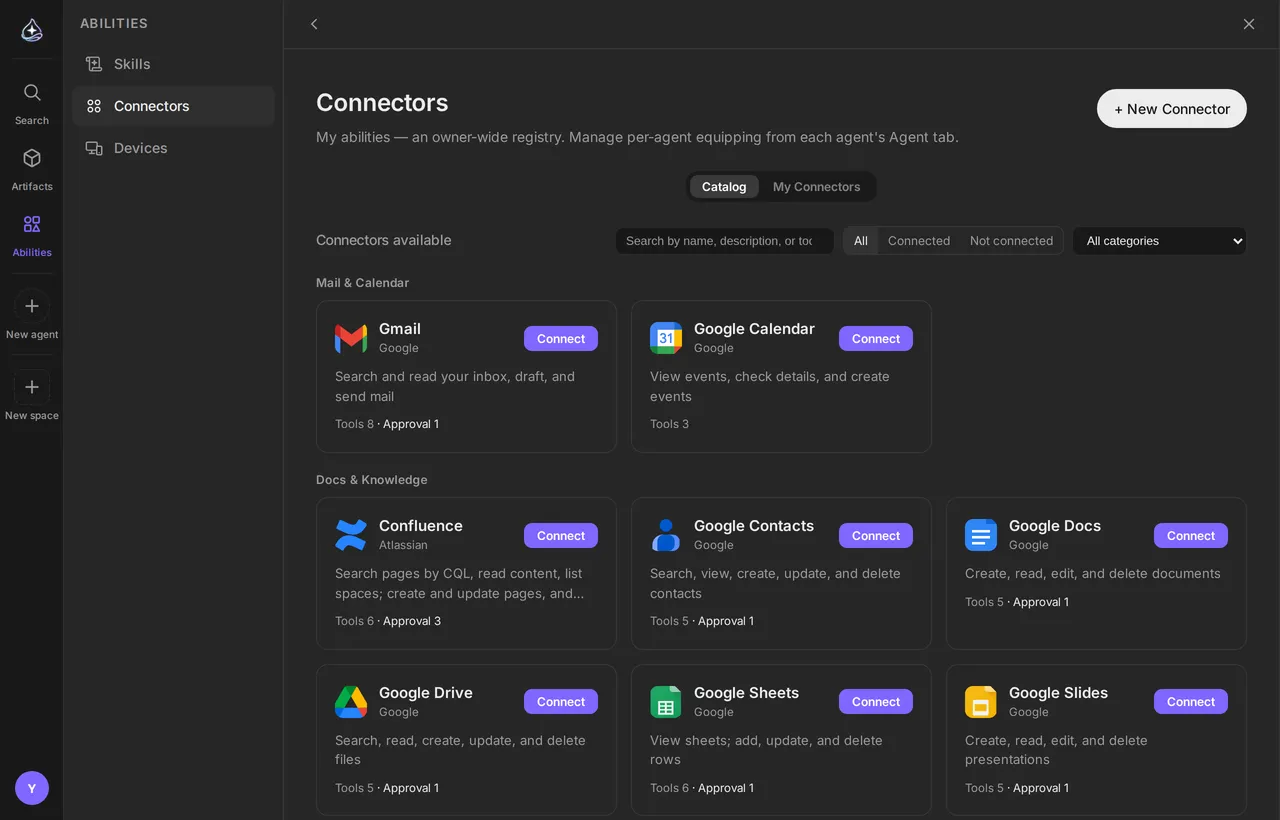](/docs/_astro/connectors-catalog.C8RNQDfg.png)
The same catalog is public at \[endue.ai/connectors]\(/connectors).[Open full size](/docs/_astro/connectors-catalog.C8RNQDfg.png)
## How to read the table
[Section titled “How to read the table”](#how-to-read-the-table)
**Sign-in** is how you authorize the connection:
| Method | What you do |
| --------------------- | ------------------------------------------------------------------------------ |
| **OAuth** | Sign in at the provider and approve access on their consent screen |
| **Token** | Create an API credential in the provider’s settings and paste it into Endue |
| **Token + address** | The same, plus the address of your own installation — for self-hosted services |
| **Sign-in + address** | Your own installation, with a username and an application token |
A few services ask for one extra field — a region, an email, a second key. The form names each one when you connect.
**Approval** lists the operations that stop for your [approval](/docs/work/approvals/) — anything that sends something outward or deletes data. Read and write operations run without interrupting you.
## Mail and calendar
[Section titled “Mail and calendar”](#mail-and-calendar)
| Service | An agent can | Sign-in | Approval |
| ---------------------------- | ------------------------------------------------ | ------- | -------- |
| **[Gmail](/docs/connect/gmail/)** | Search and read your inbox, draft, and send mail | OAuth | Send |
| **Google Calendar** | View events, check details, and create events | OAuth | — |
## Docs and knowledge
[Section titled “Docs and knowledge”](#docs-and-knowledge)
| Service | An agent can | Sign-in | Approval |
| ------------------------------ | ------------------------------------------------------------------------------------ | ------- | ----------------------- |
| **Google Drive** | Search, read, create, update, and delete files | OAuth | Delete |
| **Google Docs** | Create, read, edit, and delete documents | OAuth | Delete |
| **Google Sheets** | View sheets; add, update, and delete rows | OAuth | Delete |
| **Google Slides** | Create, read, edit, and delete presentations | OAuth | Delete |
| **Google Tasks** | View, create, complete, and delete tasks | OAuth | Delete |
| **Google Contacts** | Search, view, create, update, and delete contacts | OAuth | Delete |
| **[Notion](/docs/connect/notion/)** | Search pages and databases, read content, create and append to pages | OAuth | — |
| **Confluence** | Search pages by CQL, read content, list spaces; create and update pages, and comment | OAuth | Create, update, comment |
See [Gmail](/docs/connect/gmail/) and [Google Workspace](/docs/connect/google-workspace/) for the details that matter in practice.
## Communication
[Section titled “Communication”](#communication)
| Service | An agent can | Sign-in | Approval |
| ---------------------------- | ------------------------------------------------------------------------------ | --------------- | ----------- |
| **[Slack](/docs/connect/slack/)** | List channels, view conversation history, threads, and search; send messages | OAuth | Post |
| **Mattermost** | View teams, channels, conversation history, threads, and search; post messages | Token + address | Post |
| **Telegram** | View messages received by the bot and chats; send messages | Token | Send |
| **Discourse** | Search the forum, read topics, list categories; post topics and replies | Token + address | Post, reply |
These let an agent *read and write in* a chat service as part of its own work. For the other direction — people talking *to* an agent from Slack, Discord, KakaoTalk, NaverTalk, or WhatsApp — see [Channels](/docs/automate/channels/).
## Issues and projects
[Section titled “Issues and projects”](#issues-and-projects)
| Service | An agent can | Sign-in | Approval |
| ---------- | ---------------------------------------------------------------------------------------------------------------- | ------- | --------------------------- |
| **Jira** | Search issues by JQL, view details, list projects and transitions; create issues, comment, and transition status | OAuth | Create, comment, transition |
| **Linear** | Search and view issues; create issues, comment, and update them | OAuth | Create, comment, update |
## Development and deployment
[Section titled “Development and deployment”](#development-and-deployment)
| Service | An agent can | Sign-in | Approval |
| ---------------- | ------------------------------------------------------------------------------------ | ----------------- | ----------------- |
| **GitLab** | View projects, issues, merge requests, and pipelines; create issues and comment | Token + address | Create, comment |
| **Jenkins** | View jobs, build status, and console logs; trigger builds | Sign-in + address | Trigger |
| **Vercel** | View projects, deployment status, and build logs; redeploy and promote to production | Token | Redeploy, promote |
| **Cloudflare** | View zones, DNS, Workers, and Pages deployments; purge cache | Token | Purge |
| **LaunchDarkly** | View projects, environments, feature flags, and audit logs; toggle flags | Token | Toggle |
## Observability and incidents
[Section titled “Observability and incidents”](#observability-and-incidents)
| Service | An agent can | Sign-in | Approval |
| ----------------- | --------------------------------------------------------------------------------------------------------- | --------------- | -------------------------- |
| **Datadog** | View monitors, logs, metrics, and events; mute monitors | Token | Mute |
| **Grafana** | View dashboards, data sources, and alerts, query metrics and logs, create annotations, and silence alerts | Token + address | Silence |
| **PagerDuty** | View incidents, on-call schedules, and services; acknowledge, resolve, and add notes | Token | Acknowledge, resolve, note |
| **Elasticsearch** | View indices and mappings, search and aggregate documents | Token + address | — |
Elasticsearch is read-only by design — an agent can investigate your data and cannot change it. It also works against OpenSearch.
## Social and publishing
[Section titled “Social and publishing”](#social-and-publishing)
| Service | An agent can | Sign-in | Approval |
| ------------- | ------------------------------------------------------------------------- | ----------------- | ------------------------- |
| **WordPress** | Search and read posts, create and edit drafts, and publish | Sign-in + address | Publish, update published |
| **Reddit** | Search subreddits and posts, read comments, and submit posts and comments | OAuth | Post, comment |
| **Facebook** | View pages, posts, and reactions; publish page posts and comments | OAuth | Post, comment |
| **Instagram** | View profile, posts, and comments; reply to comments and publish images | OAuth | Reply, publish |
## Commerce and maps
[Section titled “Commerce and maps”](#commerce-and-maps)
| Service | An agent can | Sign-in | Approval |
| --------------------- | ------------------------------------------------------------------------------------------ | --------------- | ---------------- |
| **Shopify** | View products, orders, and customers; create draft products and publish them | Token + address | Publish |
| **Naver Smart Store** | View products, orders, and customer inquiries; mark orders as shipped and answer inquiries | Token | Answer, dispatch |
| **Naver Map** | Convert between addresses and coordinates, and look up driving routes | Token | — |
Commerce connectors create drafts by default
A product an agent creates in Shopify is a draft. Making it visible to shoppers is a separate, gated action.
## Design
[Section titled “Design”](#design)
| Service | An agent can | Sign-in | Approval |
| --------- | --------------------------------------------------------------------------------------------- | ------- | -------- |
| **Figma** | View file structure and nodes, export images, view and post comments | OAuth | Comment |
| **Canva** | Search designs, view details, browse folders, export files, create designs, and upload assets | OAuth | — |
## Channel-only connections
[Section titled “Channel-only connections”](#channel-only-connections)
Two entries in the catalog give an agent no tools at all. They exist so a messaging platform can reach *in*:
| Entry | What it is for |
| ----------------- | ---------------------------------------------------------------------------------------------------------------- |
| **Kakao Builder** | Receives messages from the KakaoTalk chatbot builder skill webhook and replies through the one-time callback URL |
| **NaverTalk Bot** | Receives messages from the TalkTalk event webhook and replies through the Send API |
Both are set up as [channels](/docs/automate/channels/), not as connectors bound to an agent.
## Limits
[Section titled “Limits”](#limits)
* This list is what exists today. A service that is not here cannot be reached by an agent, and there is no generic “call any API” connector.
* Each connector exposes a fixed set of operations — the ones summarized above. An agent cannot use parts of a provider’s API that Endue does not expose.
* Self-hosted services (**Token + address**, **Sign-in + address**) must be reachable from the internet.
* What an agent can actually do is the intersection of these operations and the permissions you granted at the provider.
## Related
[Section titled “Related”](#related)
[Connectors overview](/docs/connect/overview/)Connection versus binding, authorizing, and revoking.
[Approvals](/docs/work/approvals/)What the approval column means when an agent gets there.
[Troubleshooting connections](/docs/connect/troubleshooting/)When a connector stops working.
# Gmail
> Connect Gmail so an agent can search, read, and draft mail — and send only with your approval.
The Gmail connector lets an agent work through your inbox: search it, read messages and threads, prepare drafts, and — with your [approval](/docs/work/approvals/) — send.
## When to use it
[Section titled “When to use it”](#when-to-use-it)
Gmail is the connector most agents earn their keep with, because inbox work is repetitive and rule-shaped: triage, summarize, find the thing someone asked for last Tuesday, draft the reply you would have written anyway.
## Connect it
[Section titled “Connect it”](#connect-it)
1. **Open Connectors** in [Agent Builder](/docs/build/agent-builder/) and choose Gmail.
2. **Sign in with Google and approve access.** Endue receives only what the consent screen lists.
3. **Bind it to the agent** that should use it.
Check which Google account you are signing in as
If you are signed into both a work and a personal account, Google may pick the wrong one. The connection is tied to whichever account approved it.
## What an agent can do
[Section titled “What an agent can do”](#what-an-agent-can-do)
| Operation | Gated |
| ------------------------------------------ | ------- |
| Search messages, and search threads | No |
| Read a message, or a whole thread in order | No |
| List labels, list drafts | No |
| Write a draft | No |
| **Send** | **Yes** |
Search accepts Gmail’s own search syntax — `from:`, `label:`, `is:unread`, `after:`, quoted phrases. Saying *“unread mail from Sarah this week”* is enough; the agent constructs the query.
## Draft, then send
[Section titled “Draft, then send”](#draft-then-send)
The split between drafting and sending is the shape of every safe email workflow:
* **Draft** is not gated. An agent can prepare ten replies while you are away, and they sit in your Gmail drafts.
* **Send** stops and shows you the recipient, subject, and body. Approve it and exactly that message goes out.
For a [routine](/docs/automate/routines/) that runs while you are asleep, ask for drafts. A send in an unattended run is refused, not queued.
## Getting better results
[Section titled “Getting better results”](#getting-better-results)
* **Say what “handled” means.** *“Flag anything asking me a direct question, quote the question, ignore newsletters”* beats *“summarize my inbox”*.
* **Point at labels.** An agent that works from a label you already maintain inherits your triage instead of reinventing it.
* **Keep it to one mailbox.** For two Google accounts, authorize two connections and bind each to the agent that needs it.
## Limits
[Section titled “Limits”](#limits)
* One Gmail account per connection.
* An agent can read anything the authorization covers. If that is more of your mail than you are comfortable with, bind Gmail only to agents that need it.
* Attachments are not read.
* Sending always requires approval. There is no setting to allow an agent to send unattended.
## Related
[Section titled “Related”](#related)
[Google Workspace](/docs/connect/google-workspace/)Calendar, Drive, Docs, Sheets, Slides, Tasks, and Contacts.
[Approvals](/docs/work/approvals/)What you see before a message goes out.
[Routines](/docs/automate/routines/)Inbox digests that run before you wake up.
# Google Workspace
> Calendar, Drive, Docs, Sheets, Slides, Tasks, and Contacts — connected individually, so an agent gets exactly the access it needs.
Seven Google services beyond [Gmail](/docs/connect/gmail/) are available as connectors. Each is authorized **separately**, so an agent can read your calendar without touching your files.
## When to use it
[Section titled “When to use it”](#when-to-use-it)
Connect the specific service the agent’s job requires. Meeting prep needs Calendar and maybe Drive. A reporting agent needs Sheets. A writing agent needs Docs. Connecting all seven to every agent is the opposite of the intent.
## What each one does
[Section titled “What each one does”](#what-each-one-does)
| Service | An agent can | Gated |
| ------------ | ------------------------------------------------------------------------------- | ------ |
| **Calendar** | List events over a range, read one with attendees and location, create an event | — |
| **Drive** | Search, read, create, update files; delete | Delete |
| **Docs** | Create a document, read it, append, replace text; delete | Delete |
| **Sheets** | Create a spreadsheet, read a range, append rows, update cells; delete | Delete |
| **Slides** | Create a deck, read it, add a slide, replace text; delete | Delete |
| **Tasks** | List task lists and tasks, create, complete, update; delete | Delete |
| **Contacts** | Search and read contacts, create, update; delete | Delete |
Creating and updating are **not** gated — an agent can write a document or fill a sheet without interrupting you. Deleting always is.
## Connect them
[Section titled “Connect them”](#connect-them)
Each service is its own entry in the connector list, and each sends you to Google’s consent screen for that service’s permissions. Bind each connection to the agents that need it.
Authorizing all seven means seven trips through consent. That friction is intentional: the alternative is one grant that covers everything you have in Google.
Deleting through Drive
Files an agent did not create can be deleted through the Drive connector, with your approval. Read the approval prompt — it names the file.
## Patterns that work
[Section titled “Patterns that work”](#patterns-that-work)
* **Meeting prep.** Calendar to find the meeting, Drive to find the related documents, Docs to write the brief.
* **Recurring reports.** Sheets as the data source, Docs or an [artifact](/docs/capabilities/artifacts/) as the output, a [routine](/docs/automate/routines/) to run it weekly.
* **Write to Endue first, export later.** Producing an [artifact](/docs/capabilities/artifacts/) and copying it into Docs when you are happy is often better than iterating directly in a live document.
## Limits
[Section titled “Limits”](#limits)
* Each service is authorized separately; there is no single Workspace grant.
* One Google account per connection, per service.
* An agent works with files it can find through search or a link you give it. It does not browse your whole Drive to decide what is relevant.
* Endue exposes the operations in the table above, not the full Google API — advanced formatting, permissions changes, and sharing settings are out of reach.
## Related
[Section titled “Related”](#related)
[Gmail](/docs/connect/gmail/)The eighth Google connector, and the one with a send gate.
[Available connectors](/docs/connect/available-connectors/)Everything else Endue connects to.
[Artifacts](/docs/capabilities/artifacts/)Where output lands when it does not belong in a Google file.
# Notion
> Give an agent access to specific Notion pages and databases — read them, query them, and write new pages.
The Notion connector lets an agent search your workspace, read pages as plain text, query databases, and create or extend pages.
## When to use it
[Section titled “When to use it”](#when-to-use-it)
Notion is where teams keep the context an agent otherwise has to be told: specs, meeting notes, project trackers. An agent that can read it stops asking you for background, and can file its output where the rest of the team already looks.
## Connect it
[Section titled “Connect it”](#connect-it)
1. **Open Connectors** in [Agent Builder](/docs/build/agent-builder/) and choose Notion.
2. **Sign in and choose what to share.** Notion’s consent screen asks which pages the integration may access — this is the access control, and it is on Notion’s side.
3. **Bind the connection to the agent.**
Empty results usually mean a page was not shared
A search that finds nothing is more often a sharing problem than a spelling one. If a page was not included when you authorized — or was created afterwards — share it with the integration from Notion’s own page menu.
## What an agent can do
[Section titled “What an agent can do”](#what-an-agent-can-do)
| Operation | Gated |
| ------------------------------------------------------------- | ----- |
| Search pages and databases by title | No |
| Read a page as plain text, including nested lists and toggles | No |
| Query a database, filtering on one property | No |
| Create a page under a page or in a database | No |
| Append content to an existing page | No |
Nothing in Notion is gated by default, because none of these operations sends anything outward or deletes data. Creating and appending do change your workspace — the agent is instructed to confirm the location and title with you first, but the [approval](/docs/work/approvals/) gate does not stop it.
## Working with it
[Section titled “Working with it”](#working-with-it)
* **Search first.** An agent needs a page’s identifier before it can read or extend it, so a vague *“update the roadmap page”* costs a search step. Pasting the page link is faster.
* **Very long pages are truncated.** Reading a page returns as much as fits and says that it was cut. For a large document, point the agent at the section.
* **Database queries filter on one property.** Complex multi-condition views are better built in Notion, with the agent reading the result.
## Limits
[Section titled “Limits”](#limits)
* The agent sees only what you shared with the integration in Notion.
* Reading returns plain text. Notion-specific structure — databases inside pages, synced blocks, complex layouts — is flattened, and formatting is not round-tripped exactly.
* There is no delete operation.
* Pages created by the agent are owned by the Notion integration, and appear as such in page history.
## Related
[Section titled “Related”](#related)
[Connectors overview](/docs/connect/overview/)Connection versus binding, and revoking access.
[Projects](/docs/capabilities/projects/)Keeping context in Endue instead of fetching it every time.
[Available connectors](/docs/connect/available-connectors/)Linear, GitLab, and the rest of the catalog.
# Connectors overview
> Connect Endue to a service you already use, bind that connection to specific agents, and revoke it when you are done.
A **connector** links an agent to a service you already use. Endue ships connectors for more than thirty services — see [Available connectors](/docs/connect/available-connectors/).
## Connection versus binding
[Section titled “Connection versus binding”](#connection-versus-binding)
This is the one idea worth getting right, because it is what keeps an agent’s reach predictable.
1. **You authorize a connection.** You sign in at the provider — Google, Slack, Notion — or paste an API token. The resulting connection belongs to *your account*.
2. **You bind the connection to specific agents.** Only agents you bind it to can use it.
Connecting Gmail does not hand your inbox to every agent you own. An agent that has no business reading your email should not be bound to it — that narrows what can go wrong and makes the agent’s choices more predictable.
## Connect a service
[Section titled “Connect a service”](#connect-a-service)
1. **Open Connectors** in [Agent Builder](/docs/build/agent-builder/), under the agent’s Ability section, and pick the service.
2. **Authorize it.**
Most services send you to the provider to sign in and approve access; Endue receives only the permissions shown on that consent screen. Others ask for an API token you create in the provider’s own settings, sometimes together with the address of your own installation.
3. **Bind it to this agent.** The agent’s tools for that service appear on its next [run](/docs/work/runs/).
Connect the account you mean to use
A connection is tied to one account at the provider. If you have both a work and a personal Google account, check which one you are signing in as. Connecting the same service again with the same account re-authorizes the existing connection rather than creating a duplicate, so bindings are preserved.
## What an agent can do once connected
[Section titled “What an agent can do once connected”](#what-an-agent-can-do-once-connected)
Each connector exposes a set of operations, and every operation is classified by what it does: read, write, send, or destructive. **Send and destructive operations always stop for your [approval](/docs/work/approvals/)** — with the exact arguments shown — before they run.
So a connected Gmail lets an agent search and read freely, draft without asking, and send only with your say-so.
## Revoking
[Section titled “Revoking”](#revoking)
You can disconnect from either side:
* **In Endue**, remove the connection. Every agent bound to it loses those tools immediately.
* **At the provider**, revoke Endue’s access in your Google, Slack, or Notion account settings, or delete the API token.
Revoking at the provider leaves the connection in Endue in a broken state until you remove or re-authorize it. See [Troubleshooting connections](/docs/connect/troubleshooting/).
## Limits
[Section titled “Limits”](#limits)
* One account per connection, per service. To work with two Google accounts, authorize two connections.
* Connections are bound per agent. There is no “all agents” option.
* A connector exposes a fixed set of operations. It is not a general-purpose API client — an agent cannot call arbitrary endpoints at the provider.
* Endue can only do what the provider’s authorization allows. If a scope was not granted, the operation fails at the provider, not silently.
## Related
[Section titled “Related”](#related)
[Available connectors](/docs/connect/available-connectors/)Every service you can connect, and what an agent can do with it.
[Approvals](/docs/work/approvals/)Which operations stop and ask you first.
[Troubleshooting connections](/docs/connect/troubleshooting/)Expired tokens, revoked access, wrong account.
# Slack
> Let an agent read Slack channels and threads, search the workspace, and post — with your approval.
The Slack connector lets an agent read what happened in your workspace and, with your [approval](/docs/work/approvals/), post to it.
## When to use it
[Section titled “When to use it”](#when-to-use-it)
Slack is where decisions get made and then lost. An agent that can search it turns *“someone posted the deploy checklist a month ago”* into a working answer, and can summarize a channel you were away from.
If you want the opposite direction — asking an agent something *from inside Slack* — see [Channels](/docs/automate/channels/).
## Connect it
[Section titled “Connect it”](#connect-it)
1. **Open Connectors** in [Agent Builder](/docs/build/agent-builder/) and choose Slack.
2. **Sign in and approve the workspace.** Access is per workspace.
3. **Invite the app to the channels it should read.** This is the step people miss — see below.
4. **Bind the connection to the agent.**
A channel the app is not in cannot be read
Reading a channel’s history requires the Slack app to be a member of that channel. If an agent reports that it is not in the channel, invite it there in Slack and try again. Workspace search does not have this requirement.
## What an agent can do
[Section titled “What an agent can do”](#what-an-agent-can-do)
| Operation | Gated |
| ------------------------------- | ------- |
| List channels | No |
| Read a channel’s recent history | No |
| Search the workspace | No |
| Read a thread’s replies | No |
| **Post a message** | **Yes** |
Search uses Slack’s own syntax — `from:@user`, `in:#channel`, quoted phrases — and is the right starting point when you do not know which channel something is in.
## Posting
[Section titled “Posting”](#posting)
Posting is gated, like every outbound action. You see the channel and the exact text before it goes out, and approving sends precisely that.
In an unattended run — a [routine](/docs/automate/routines/), for example — a post is refused rather than held. A scheduled Slack digest should write an [artifact](/docs/capabilities/artifacts/) and notify you, or you should post it yourself once you have read it.
## Limits
[Section titled “Limits”](#limits)
* One Slack workspace per connection.
* Reading history requires the app to be in the channel. Private channels it has not been invited to are invisible.
* Direct messages are not covered.
* Posting always requires approval, including replies in a thread.
* The agent posts as the Endue app, not as you.
## Related
[Section titled “Related”](#related)
[Channels](/docs/automate/channels/)Reaching an agent from inside Slack, rather than the reverse.
[Approvals](/docs/work/approvals/)What you see before a message is posted.
[Available connectors](/docs/connect/available-connectors/)Mattermost, Telegram, and everything else.
# Troubleshooting connections
> Expired tokens, revoked access, the wrong account, and permission errors — what each one looks like and how to fix it.
A connector that worked yesterday and fails today has usually hit one of five things. This page is the shortlist, in the order they occur.
## Start here
[Section titled “Start here”](#start-here)
Open the agent’s connectors in [Agent Builder](/docs/build/agent-builder/). A connection that needs attention is marked there, and the fix is almost always to authorize it again.
**Re-authorizing keeps your bindings.** Connecting the same service with the same account re-authorizes the existing connection rather than creating a second one, so you do not have to rebind it to every agent afterwards.
## The five causes
[Section titled “The five causes”](#the-five-causes)
### The authorization expired
[Section titled “The authorization expired”](#the-authorization-expired)
Providers expire access after a period — some quickly, some after months. The connection is marked as needing re-authorization and the agent’s tools for that service stop working.
**Fix:** connect again with the same account.
### Access was revoked at the provider
[Section titled “Access was revoked at the provider”](#access-was-revoked-at-the-provider)
Someone removed Endue in Google account settings, uninstalled the Slack app, or deleted the API token. Endue cannot tell this apart from an expiry until it tries.
**Fix:** re-authorize, or create a new token and reconnect. If the revocation was deliberate, remove the connection in Endue so the state is honest.
### You connected the wrong account
[Section titled “You connected the wrong account”](#you-connected-the-wrong-account)
The classic case: you were signed into a personal Google account when you approved a work connector. Nothing errors — the agent finds nothing, because it is looking in the wrong inbox.
**Fix:** sign out of the wrong account at the provider, or use a private window, and connect again with the account you meant. Check the account shown on the consent screen before approving.
### The agent lacks access to the specific resource
[Section titled “The agent lacks access to the specific resource”](#the-agent-lacks-access-to-the-specific-resource)
The connection is fine; the resource is not shared with it.
| Service | Symptom | Fix |
| ---------- | --------------------------------------------- | ---------------------------------------------------------------------- |
| **Slack** | “Not in channel” when reading history | Invite the app to that channel in Slack |
| **Notion** | Search returns nothing for a page you can see | Share the page with the integration from Notion |
| **GitLab** | A project or issue is reported as not found | The token’s user may not have access — check permissions, not spelling |
| **Google** | A file is not found | The account you connected may not have access to it |
Not found often means not permitted
Several providers return “not found” rather than “not allowed” for things you cannot see, to avoid revealing that they exist. Treat a not-found on something you are sure exists as a permission problem first.
### A self-hosted service moved or is unreachable
[Section titled “A self-hosted service moved or is unreachable”](#a-self-hosted-service-moved-or-is-unreachable)
Connectors that ask for an address — GitLab, Jenkins, Discourse, WordPress, Mattermost, Grafana, Elasticsearch — need that address reachable from the internet.
**Fix:** confirm the address is correct and publicly reachable, then reconnect. A service behind a VPN cannot be reached.
## When the connector is fine and the agent still fails
[Section titled “When the connector is fine and the agent still fails”](#when-the-connector-is-fine-and-the-agent-still-fails)
* **The operation does not exist.** Each connector exposes a fixed set of operations — check [Available connectors](/docs/connect/available-connectors/). An agent cannot use part of a provider’s API that Endue does not expose.
* **The connection is not bound to *this* agent.** Connecting is account-level; using is per agent.
* **The tool group is switched off.** Check the agent’s [built-in tools](/docs/capabilities/built-in-tools/) if the missing capability is memory, artifacts, routines, or web fetch rather than a connector.
* **The action was rejected at the [approval](/docs/work/approvals/) gate**, including automatically, because the run was unattended.
## Removing a connection
[Section titled “Removing a connection”](#removing-a-connection)
Removing it in Endue immediately withdraws those tools from every agent bound to it. Existing conversations keep their history; the agent can no longer make those calls.
Removing a connection in Endue does not revoke Endue at the provider. For a clean break, do both.
## Related
[Section titled “Related”](#related)
[Connectors overview](/docs/connect/overview/)How connecting, binding, and revoking fit together.
[Troubleshooting](/docs/troubleshooting/)Problems that are not about connections.
[Security and permissions](/docs/account/security/)What an agent can reach, and what it cannot.
# Core concepts
> The nine ideas that explain how Endue works — agent, conversation, run, tool, skill, connector, memory, artifact, and routine.
Endue has a small vocabulary. Learn these nine ideas and the rest of the product explains itself.
## Agent
[Section titled “Agent”](#agent)
An **agent** is a durable identity that does work on your behalf. It is not a chat window you throw away — it has a name and handle you can address, a profile, a character that shapes how it responds, and a system prompt that defines its job.
The system prompt is kept under revision history. You can change how an agent behaves, see exactly what changed, and roll back when a change turns out to be worse.
An agent only has the abilities you give it. On its own it can reason, calculate, and read public web pages. Everything else — your email, your calendar, your documents — requires a connection you explicitly bind to it.
## Conversation
[Section titled “Conversation”](#conversation)
A **conversation** is a continuous thread with an agent. It holds the message history the agent reads for context, and it persists: close the tab, come back tomorrow, and the agent still knows what you were discussing.
Conversations belong to you. They can be grouped into a **project** when several of them are about the same body of work.
## Run
[Section titled “Run”](#run)
A **run** is one turn of the agent actually working. You send a message, and the agent begins a run: it decides what to do, calls tools, reads the results, and repeats until it has an answer or needs something from you.
Three things about runs matter in practice:
* **You can watch it.** Each step is visible as it happens — which tool was called, with what, and what came back.
* **You can steer it.** Send a correction while the run is still going and the agent picks it up on its next step. You do not have to let a bad run finish.
* **It survives you leaving.** Close the app mid-run and the work continues on the server. Come back and the result is there.
A run can also pause and ask you something — a choice between options, a piece of text, or approval for an action. See [Approvals](#approval) below.
## Tool
[Section titled “Tool”](#tool)
A **tool** is a single capability an agent can invoke during a run: read a file, search email, create a calendar event, write an artifact, recall a memory.
Some tools are built in and always available. Others appear only when you connect a service or bind a skill. The agent chooses which tools to call; you choose which tools exist.
## Skill
[Section titled “Skill”](#skill)
A **skill** packages a repeatable job so you do not have to re-explain it — a procedure, a checklist, a set of commands the agent can run.
Bind a skill to an agent and it becomes part of what that agent can do. An agent can also *request* a skill it has not been given: it pauses mid-run and asks, and you approve or decline in the conversation.
## Connector
[Section titled “Connector”](#connector)
A **connector** links an agent to a service you already use — Gmail and the rest of Google Workspace, Slack, Notion, Linear, GitLab, Shopify, Figma, Datadog, and [more than thirty others](/docs/connect/available-connectors/).
Connecting is a two-step idea worth understanding:
1. **You authorize the connection** at the provider — Google, Slack, or Notion — and it belongs to your account.
2. **You bind the connection to specific agents.** Connecting Gmail does not hand every agent your inbox.
Connections can be revoked at any time, from Endue or from the provider.
One account per connection
A connection is tied to one account at the provider. Connecting the same service again with the same account re-authorizes the existing connection rather than creating a duplicate, so agent bindings are preserved.
## Memory
[Section titled “Memory”](#memory)
**Memory** is what an agent retains across conversations — facts about you, your preferences, how you like work done. The agent decides what is worth remembering, and recalls it when relevant.
Memory is inspectable and editable. You can see what an agent has stored and delete anything that should not have been kept.
## Artifact
[Section titled “Artifact”](#artifact)
An **artifact** is something the agent produced that is worth keeping — a report, a document, a diagram, a dataset. Rather than burying it in a chat transcript, Endue gives it its own page.
Artifacts are private to you by default. You can share one with a link, which grants access to that artifact and nothing else — useful for handing a result to someone outside your workspace.
## Routine
[Section titled “Routine”](#routine)
A **routine** is a task on a schedule. Instead of asking an agent to do something, you describe the job once and give it a cadence — every weekday morning, every Monday, the first of the month.
Routines run whether or not you have Endue open. What they produce lands in your workspace, and if a routine needs a decision it asks you and waits.
## Approval
[Section titled “Approval”](#approval)
An **approval** is Endue stopping to ask before an agent does something you cannot take back.
Two categories always require it:
* **Outbound actions** — sending an email, posting a message, anything that leaves your account and reaches another person.
* **Destructive actions** — deleting or overwriting data.
When an agent wants to take one, the run pauses and shows you the exact action, with the exact arguments. Approve and it proceeds with precisely what you saw. Reject and the agent adapts and keeps working.
This applies to scheduled and event-triggered runs too. If nobody is there to approve, the action is refused rather than left hanging.
## How they fit together
[Section titled “How they fit together”](#how-they-fit-together)
> You give an **agent** an identity and bind **connectors** and **skills** to it. You talk to it in a **conversation**; each turn is a **run** in which it calls **tools**. It stores what it learns as **memory**, produces **artifacts**, and asks for **approval** before anything leaves your account. When the work repeats, it becomes a **routine**.
## What to read next
[Section titled “What to read next”](#what-to-read-next)
[Quickstart](/docs/get-started/quickstart/)Put these concepts to work — build an agent end to end.
[Glossary](/docs/get-started/glossary/)Every Endue term, including the ones not covered here.
# Glossary
> Definitions for Endue terminology — agent, run, skill, connector, memory, artifact, routine, and the rest of the vocabulary you will meet in the product.
This glossary defines every term Endue uses. Each entry links to the page where the concept is covered properly. A term that appears in the product but not on this page is a documentation bug — please tell us.
## A
[Section titled “A”](#a)
### Agent
[Section titled “Agent”](#agent)
A durable identity that does work on your behalf, with its own [handle](#handle), profile, [character](#character), and [system prompt](#system-prompt). Unlike a chat window you open and discard, an agent persists: it keeps its abilities, its [memory](#memory), and its history. An agent can only reach what you have [bound](#binding) to it.
Learn more: [Core concepts](/docs/get-started/core-concepts/#agent)
### Agent Builder
[Section titled “Agent Builder”](#agent-builder)
The part of the web app where you create and tune agents — identity, system prompt, model, and the [skills](#skill) and [connections](#connection) bound to them.
The name is Agent Builder. “Studio” is not a product name and does not appear in the interface.
Learn more: [Agent Builder](/docs/build/agent-builder/)
### Approval
[Section titled “Approval”](#approval)
A pause in a [run](#run) where Endue asks you to confirm before the agent takes an action you cannot take back. Two categories always trigger it: **outbound** actions that leave your account and reach another person, and **destructive** actions that delete or overwrite data.
You see the exact action with the exact arguments before deciding. This gate is not configurable. In a [routine](#routine) or any other run nobody is watching, the action is refused rather than left waiting.
Learn more: [Approvals](/docs/work/approvals/) · [Core concepts](/docs/get-started/core-concepts/#approval)
### Artifact
[Section titled “Artifact”](#artifact)
A document, report, diagram, or dataset an agent produced, stored on its own page rather than buried in a [conversation](#conversation). Artifacts are private to you by default and can be shared with a link that grants access to that one artifact and nothing else.
Learn more: [Artifacts](/docs/capabilities/artifacts/)
## B
[Section titled “B”](#b)
### Binding
[Section titled “Binding”](#binding)
The link between an [agent](#agent) and a capability it is allowed to use. [Connections](#connection) and [skills](#skill) are bound to specific agents — holding a connection in your account does not grant it to every agent you own.
Binding is what keeps an agent’s reach predictable. An agent with three tools behaves more consistently than one with twenty.
Learn more: [Connectors overview](/docs/connect/overview/#connection-versus-binding)
### BYOK
[Section titled “BYOK”](#byok)
“Bring your own key.” Using your own model-provider credentials for an agent’s model calls instead of Endue’s.
Learn more: [Bring your own key](/docs/account/bring-your-own-key/)
## C
[Section titled “C”](#c)
### Channel
[Section titled “Channel”](#channel)
A pairing that lets people reach an agent from outside Endue — a Discord server or a Slack workspace. The opposite direction from a [connector](#connector), which lets an agent reach a service.
Learn more: [Channels](/docs/automate/channels/)
### Character
[Section titled “Character”](#character)
The disposition that shapes an agent’s tone and style. Separate from the [system prompt](#system-prompt), which defines the job rather than the manner.
### Connection
[Section titled “Connection”](#connection)
An authorized link between your Endue account and an external service — your Gmail account, your Slack workspace, your Notion. A connection is tied to one account at the provider and can be revoked from either side at any time.
Connecting a service is not the same as granting it: a connection must be [bound](#binding) to an agent before that agent can use it.
Learn more: [Connectors overview](/docs/connect/overview/)
### Connector
[Section titled “Connector”](#connector)
The integration that makes a service connectable. Gmail is a connector; your authorized Gmail account is a [connection](#connection). Endue ships connectors for more than thirty services.
Learn more: [Available connectors](/docs/connect/available-connectors/)
### Conversation
[Section titled “Conversation”](#conversation)
A continuous, persistent thread with an agent. It holds the message history the agent reads for context and survives closing the app. Conversations can be grouped into a [project](#project) when several of them concern the same body of work.
Learn more: [Conversations](/docs/work/conversations/)
## H
[Section titled “H”](#h)
### Handle
[Section titled “Handle”](#handle)
The short name you use to address an agent. Chosen when the agent is created and stable afterwards.
## I
[Section titled “I”](#i)
### Inbox
[Section titled “Inbox”](#inbox)
Where notifications land: a [run](#run) finished, a [routine](#routine) completed or failed, something is waiting on your decision. It tells you what happened; you act on it in the conversation it points to.
Learn more: [Notifications and inbox](/docs/work/inbox/)
## M
[Section titled “M”](#m)
### Memory
[Section titled “Memory”](#memory)
What an agent retains across [conversations](#conversation) — facts about you, your preferences, how you like work done. The agent decides what is worth keeping and recalls it when relevant, so memory is selected rather than dumped into every [run](#run).
Memory is inspectable and editable: you can see what an agent stored and delete anything that should not have been kept.
Learn more: [Memory](/docs/capabilities/memory/)
## P
[Section titled “P”](#p)
### Project
[Section titled “Project”](#project)
A grouping of [conversations](#conversation), [artifacts](#artifact), and [routines](#routine) that belong to the same body of work. An agent working inside a project sees the project’s context, which is the cheapest way to stop re-explaining background in every conversation.
Learn more: [Projects](/docs/capabilities/projects/)
## R
[Section titled “R”](#r)
### Reasoning effort
[Section titled “Reasoning effort”](#reasoning-effort)
How much thinking a model does before it answers. Higher effort costs more tokens and takes longer, and pays off on multi-step work where an early wrong turn wastes the rest of the [run](#run). Available on models that support it.
Learn more: [Choosing a model](/docs/build/models/#reasoning-effort)
### Revision
[Section titled “Revision”](#revision)
A saved version of an agent’s [system prompt](#system-prompt). Prompts are versioned so a change can be reviewed and rolled back — which is what makes prompt iteration safe rather than a gamble.
Learn more: [System prompt and revisions](/docs/build/system-prompt/#revisions-and-rollback)
### Routine
[Section titled “Routine”](#routine)
A task an agent performs on a schedule, running whether or not you have Endue open. What a routine produces waits for you in your workspace. If it needs a decision it asks, and an [approval](#approval) it cannot get is refused rather than left hanging.
Learn more: [Routines](/docs/automate/routines/)
### Run
[Section titled “Run”](#run)
One turn of an agent working: read the context, decide, call a [tool](#tool), read the result, repeat until done or until it needs you. Runs execute on Endue’s servers, so closing the app does not stop the work.
Learn more: [Runs](/docs/work/runs/) · [How Endue works](/docs/get-started/how-it-works/#the-loop)
## S
[Section titled “S”](#s)
### Skill
[Section titled “Skill”](#skill)
A packaged, repeatable job — a procedure, a checklist, a set of commands — that can be [bound](#binding) to an agent so you do not have to re-explain it. An agent can also request a skill it has not been given, pausing mid-[run](#run) for you to grant or decline.
Learn more: [Skills](/docs/capabilities/skills/)
### Space
[Section titled “Space”](#space)
A shared workspace where a team uses the same agents and sees the work they produce.
### Steering
[Section titled “Steering”](#steering)
Sending a correction to an agent while a [run](#run) is still in progress. The agent picks it up on its next step, so a correction costs one step rather than the whole run.
Learn more: [Steering a run](/docs/work/steering/)
### Surface
[Section titled “Surface”](#surface)
One of the places you can use Endue: the web app, the desktop app, mobile, or the command line. All surfaces reach the same agents, conversations, and history — you can start on one and continue on another.
Learn more: [Surfaces](/docs/get-started/surfaces/)
### System prompt
[Section titled “System prompt”](#system-prompt)
The standing instructions an agent reads before every conversation: what it does, what it must never do, and what a good result looks like. Kept under [revision](#revision) history.
Learn more: [System prompt and revisions](/docs/build/system-prompt/)
## T
[Section titled “T”](#t)
### Tool
[Section titled “Tool”](#tool)
A single capability an agent can invoke during a [run](#run) — read a file, search email, create a calendar event, write an [artifact](#artifact), recall a [memory](#memory). Tools are what make an agent able to act rather than only advise.
Some tools are built in and always present. Others appear only when a [connection](#connection) or [skill](#skill) is bound to the agent.
Learn more: [Built-in tools](/docs/capabilities/built-in-tools/) · [Core concepts](/docs/get-started/core-concepts/#tool)
### Tool call
[Section titled “Tool call”](#tool-call)
One invocation of a tool within a run, visible to you as it happens, along with what it returned.
***
## Retired terms
[Section titled “Retired terms”](#retired-terms)
These appear in older material. Use the current name.
| Old term | Now called | Notes |
| ----------------------------- | ------------------------------- | -------------------------------------------- |
| Studio | [Agent Builder](#agent-builder) | Never a product name; do not reintroduce it |
| Character build, quest, party | — | The RPG framing is retired from product copy |
# How Endue works
> What actually happens between the moment you send a message and the moment an agent hands you a result.
When you ask an Endue agent to do something, it does not answer in one shot. It works in a loop: decide, act, look at what came back, decide again. Understanding that loop is what turns a frustrating agent into a useful one, because almost every question about behavior — why it did that, why it stopped, why it asked you something — is a question about the loop.
## The loop
[Section titled “The loop”](#the-loop)
A **run** is one pass through this cycle, repeated until the agent has an answer or needs you.
1. **Read the context.** Before anything else the agent assembles what it knows: its system prompt, the conversation so far, relevant memories, and the project it is working in.
2. **Decide.** It picks the next action — call a tool, ask you a question, or answer.
3. **Act.** If it chose a tool, the tool runs. You see the call and its result as it happens.
4. **Look at the result.** The tool’s output goes back into the context. A failed call is information too: the agent sees the error and can try something else.
5. **Repeat.** Back to step 2 with more information than before.
The agent exits the loop when it has what it needs, when it needs something from you, or when it hits a limit.
## What the agent can see
[Section titled “What the agent can see”](#what-the-agent-can-see)
An agent is not omniscient about your account, and this is deliberate. At the start of a run its context contains:
| Included | Not included |
| ---------------------------------------------------- | -------------------------------------------------------------------------- |
| Its system prompt, at the current revision | Other agents’ conversations |
| This conversation’s history | Conversations you had with this agent elsewhere, unless in the same thread |
| Memories it saved that are relevant now | Everything it ever remembered — memory is selected, not dumped |
| The project’s context, if the conversation is in one | Data from services you have not connected |
| The tools it is allowed to use | Tools bound to other agents |
This is why binding matters. Connecting Gmail to your account does not put your inbox in every agent’s context — you bind the connection to the agents that need it, and only those agents can see it.
## Why runs pause
[Section titled “Why runs pause”](#why-runs-pause)
A run stops mid-flight for exactly three reasons. Each one looks different in the conversation.
**It needs information only you have.** The agent asks a question — a choice between options, some free text, or a set of preferences — and waits. Answering resumes the work.
**It wants to do something irreversible.** Sending an email, posting a message, deleting data. The run pauses and shows you the exact action with the exact arguments. This gate is not configurable.
**It wants an ability it does not have.** If a skill would help but is not bound to it, the agent can ask for it rather than failing. You grant or decline in the conversation.
Pausing is not failing
A paused run is holding its place, not starting over. When you answer, the agent continues with everything it had already worked out.
## Where the work happens
[Section titled “Where the work happens”](#where-the-work-happens)
Runs execute on Endue’s servers, not in your browser tab. That has one consequence worth knowing: **closing the app does not stop the work.**
Start a long task, close the tab, and come back later — the run kept going, and the result is waiting. This is also what makes routines possible: a scheduled run does not need anyone to be watching.
If you want the opposite — work that happens on your own machine, with access to your local files — that is what the desktop app’s local runtime is for. See [Surfaces](/docs/get-started/surfaces/).
## What this means in practice
[Section titled “What this means in practice”](#what-this-means-in-practice)
Three habits follow directly from how the loop works:
**Give the agent a way to check itself.** The loop is only as good as the feedback in step 4. A task where the agent can verify its own work — search and confirm, write and re-read — goes better than one where it has to get it right blind.
**Be specific about the goal, not the steps.** The agent picks its own actions in step 2. Telling it *what a good result looks like* gives it something to aim at; scripting each step fights the loop.
**Correct early.** You can steer a run while it is going. A correction at step 3 costs one step; the same correction after the run finishes costs the whole run.
## What to read next
[Section titled “What to read next”](#what-to-read-next)
[Core concepts](/docs/get-started/core-concepts/)The vocabulary this page assumed — agent, run, tool, skill, memory.
[Quickstart](/docs/get-started/quickstart/)Watch the loop happen with an agent you build yourself.
# Quickstart
> Build an Endue agent, connect it to a tool you already use, and get a real result — in about ten minutes.
This walks you through building one agent that does something genuinely useful, rather than a toy that only talks. By the end you will have an agent with its own identity, a tool connection, and a result you can point at.
## Before you begin
[Section titled “Before you begin”](#before-you-begin)
Make sure you have:
* An Endue account, signed in on the web.
* About ten minutes.
* An account at a service you want the agent to work with — Gmail, Google Calendar, Slack, Notion, or [any of the others](/docs/connect/available-connectors/). Step 3 connects one of them. Use an account whose data you are comfortable experimenting with.
Note
This guide covers the web app. Endue also runs on the [desktop, mobile, and the command line](/docs/get-started/surfaces/) — the agent you build here works from all of them.
## Build your first agent
[Section titled “Build your first agent”](#build-your-first-agent)
1. **Create the agent.**
Go to **Agents** and choose **New agent**. Give it a name and a handle — the handle is how you address it later, so keep it short.
Write one sentence describing what this agent is for. Be specific: *“Summarizes my unread email every morning and flags anything needing a reply”* produces a far better agent than *“email assistant”*.
2. **Give it a system prompt.**
Open the agent and write its system prompt — the standing instructions it reads before every conversation. Say what it should do, what it should never do, and what a good result looks like.
Endue keeps every version of this prompt. Change it freely; if a change makes the agent worse, roll back to the revision that worked.
3. **Connect a tool.**
Open **Connectors** in Agent Builder and connect the service you want the agent to work with — Gmail, Google Calendar, Slack, Notion, or any of the [the full catalog](/docs/connect/available-connectors/).
You will be sent to that provider to sign in and approve access. Endue only receives the permissions shown on that consent screen, and you can revoke them at any time.
Then bind the connection to your agent, so this agent — and not every agent in your account — can use it.
Connect the account you mean to use
Connections are tied to a specific account at the provider. If you have both a work and a personal Google account, check which one you are signing in as.
4. **Ask it to do something real.**
Open a conversation with the agent and give it an actual task, not a test — *“Find every email from this week that I haven’t replied to and summarize what each one is asking for.”*
The agent works in a **run**: it decides which tools to call, calls them, reads the results, and keeps going until it has an answer. You can watch each step as it happens.
5. **Steer it if it goes the wrong way.**
You do not have to wait for a bad run to finish. Send a correction while it is still working and the agent picks it up on its next step.
6. **Approve anything that leaves your account.**
If the agent tries to send an email, post a message, or delete something, it stops and asks you first. Approve it and the agent continues with exactly the action you saw; reject it and the agent adapts.
This gate is not optional and cannot be turned off for outbound or destructive actions.
7. **Find what it produced.**
Anything substantial the agent writes — a report, a summary, a document — becomes an **artifact** with its own page under **Artifacts**. Artifacts are private to you by default. Share one with a link when you want someone outside your workspace to read it, without giving them access to anything else.
Screenshots are on the way
This guide is written for readers who can follow along in the product. Annotated screenshots for each step are generated automatically from the app and land in a later revision of this page.
## Make it recurring
[Section titled “Make it recurring”](#make-it-recurring)
The agent you just built runs when you ask it to. Most of the value shows up when it runs without you.
Turn the same task into a **routine** with a schedule — every weekday at 8am, every Monday, the first of the month. The routine runs whether or not you have Endue open, and what it produces is waiting for you when you come back. If it needs a decision, it asks, and you will see the request in your inbox.
## Getting a better agent
[Section titled “Getting a better agent”](#getting-a-better-agent)
The difference between an agent that helps and one that annoys is usually in how you set it up, not which model it uses. Once you have tried these, [Testing and iterating](/docs/build/iterating/) covers how to change an agent without breaking one that already works.
Say what a good result looks like
The agent picks its own steps. What it cannot guess is your standard for “done”.
Instead of *“summarize my email”*, try *“summarize my unread email; group by sender; for anything asking me a direct question, quote the question verbatim so I can answer without opening it.”*
Put the standing rules in the system prompt, not in every message
Anything you would repeat in every conversation belongs in the system prompt: who you are, what you care about, what the agent should never do, the format you want results in.
Prompts are versioned, so this is safe to iterate on — change it, see if the agent gets better, roll back if it does not.
Give it one job
An agent with a narrow purpose and three tools outperforms one with a vague purpose and twenty. Build a second agent rather than widening the first.
Correct it while it is working
Watching a run go the wrong way and waiting for it to finish wastes the whole run. Send the correction as soon as you see the problem — the agent picks it up on its next step.
Bind only the connections it needs
Connections are bound per agent for a reason. An agent that does not need your calendar should not have it — it narrows what can go wrong and makes the agent’s choices more predictable.
## What to read next
[Section titled “What to read next”](#what-to-read-next)
[Core concepts](/docs/get-started/core-concepts/)What an agent, run, skill, connector, memory, and artifact actually are.
[How Endue works](/docs/get-started/how-it-works/)The loop behind every run, and why runs pause when they do.
[Agent Builder](/docs/build/agent-builder/)Every setting that decides how your agent behaves.
[Routines](/docs/automate/routines/)Turn what you just built into work that happens without you.
## Getting help
[Section titled “Getting help”](#getting-help)
* **Search these docs** — press `Ctrl`/`⌘` + `K` from any page.
* **Ask your agent** — every page here is available as Markdown, and the whole site is indexed at [`/llms.txt`](/docs/llms.txt). Point an agent at it and ask.
* **Email us** — .
# Surfaces
> Endue runs in the browser, on the desktop, on your phone, and in the terminal. Every surface talks to the same agents and the same history.
A **surface** is one of the places you can use Endue. They are not separate products: your agents, conversations, connections, and artifacts are the same everywhere, so you can start a task in the browser and answer the agent’s question from your phone an hour later.
Pick a surface by what you are trying to do, not by preference — each one is better at something different.
* Web
**The full workspace, nothing to install.**
Everything Endue does is available in the browser: building and tuning agents, chatting with them, connecting tools, writing skills, scheduling routines, reviewing artifacts, and managing billing.
Use the web when you are *building* — creating an agent, changing a prompt, wiring up a connector. The other surfaces are better at *watching* and *responding*.
* Desktop
**The workspace, plus your own machine.**
A native app for macOS, Windows, and Linux. It gives you the same workspace as the web, and additionally can host agent runs locally — which is what lets an agent reach files and tools that live on your computer rather than in a cloud service.
Use the desktop app when the work involves local files, or when you want runs to keep going on your own hardware.
Setup docs in progress
Install and pairing instructions are being written and will appear here.
* Mobile
**For responding, not building.**
iOS and Android apps focused on the moments when an agent needs you: it asked a question, it wants approval to send something, or it finished and you want to read the result.
Use mobile to keep long-running work moving while you are away from a desk.
Setup docs in progress
Install instructions are being written and will appear here.
* CLI
**Endue in a pipe.**
A single `endue` binary that is both a local runtime and a command-line client. It is designed to compose with other tools rather than replace them:
| Command | What it does |
| --------------- | ------------------------------------------- |
| `endue chat` | Interactive session in your terminal |
| `endue run` | One-shot task — reads stdin, writes stdout |
| `endue session` | List and resume past sessions |
| `endue agent` | Inspect and select agents |
| `endue serve` | Run the local runtime that hosts agent work |
| `endue daemon` | Install the runtime as a background service |
Use the CLI for scripting and automation — feeding logs into an agent, running a task in CI, chaining Endue into an existing shell workflow.
Not yet generally available
The CLI is not released for general use. Install instructions will appear here when it ships.
## Choosing a surface
[Section titled “Choosing a surface”](#choosing-a-surface)
| I want to… | Use |
| -------------------------------------------------- | ----------- |
| Create an agent or change how it behaves | Web |
| Connect a tool or manage permissions | Web |
| Let an agent work with files on my computer | Desktop |
| Answer an agent’s question while away from my desk | Mobile |
| Approve an action an agent wants to take | Any surface |
| Pipe data into an agent, or run one in a script | CLI |
## What to read next
[Section titled “What to read next”](#what-to-read-next)
[Quickstart](/docs/get-started/quickstart/)Build your first agent in the web app.
[Core concepts](/docs/get-started/core-concepts/)The vocabulary every surface shares.
# Troubleshooting
> The agent did the wrong thing, the run will not finish, nothing happened — the common symptoms and what actually fixes each one.
Symptoms, in the order they come up. Connector-specific problems have their [own page](/docs/connect/troubleshooting/).
## The agent did the wrong thing
[Section titled “The agent did the wrong thing”](#the-agent-did-the-wrong-thing)
Read the [run](/docs/work/runs/) before changing anything — the tool calls show where it went wrong, and the fix follows from that.
| What you see in the run | Cause | Fix |
| ------------------------------------------------------ | ---------------------------------------------------------------------------------------- | ---------------------------------------------------------------------------------- |
| It called no tools and answered from general knowledge | It does not know it should look something up | Say so in the [system prompt](/docs/build/system-prompt/); check the connector is bound |
| It called the right tool with wrong arguments | Missing context | Put the fact in the prompt or [memory](/docs/capabilities/memory/) |
| It looped without converging | Task underspecified, or [effort](/docs/build/models/#reasoning-effort) too low for its length | Narrow the task; raise effort |
| The answer is right but unusable | No stated standard for “done” | Describe the output you want in the prompt |
| It asked you something obvious | The fact is not anywhere it can see | Prompt, memory, or [project](/docs/capabilities/projects/) |
If one steering sentence reliably rescues the run, that sentence belongs in the prompt. See [Testing and iterating](/docs/build/iterating/).
## The run is not finishing
[Section titled “The run is not finishing”](#the-run-is-not-finishing)
**It is paused, waiting for you.** A [question](/docs/work/questions/), an [approval](/docs/work/approvals/), or a [skill request](/docs/capabilities/skills/#when-an-agent-asks-for-a-skill) holds the run indefinitely. Scroll to the bottom of the conversation — the prompt is there.
**It hit the step limit.** Long tasks end without a final answer. Ask it to continue, or split the task.
**It failed.** The error is in the conversation. A model error usually means the model provider rejected the call — with [BYOK](/docs/account/bring-your-own-key/), check the key and its credit.
**You closed the app.** That does not stop anything. Runs finish on Endue’s servers and the result is in the thread when you return.
## Nothing happens when I send a message
[Section titled “Nothing happens when I send a message”](#nothing-happens-when-i-send-a-message)
* **A run is already going.** A message sent during a run [steers](/docs/work/steering/) it rather than starting a new turn.
* **You are out of allowance.** Runs are declined when the week’s allowance is exhausted — see [Plans and usage](/docs/account/plans-and-usage/).
* **You were signed out.** Sessions end after a period of inactivity; sign in again and the conversation is where you left it.
## The agent lost a capability it had
[Section titled “The agent lost a capability it had”](#the-agent-lost-a-capability-it-had)
| Symptom | Check |
| ------------------------------------------ | ------------------------------------------------------------------------------------------------------------------ |
| A connector’s tools are gone | The connection needs re-authorizing, or was unbound — see [Troubleshooting connections](/docs/connect/troubleshooting/) |
| It stopped remembering things | The memory [tool group](/docs/capabilities/built-in-tools/) may be switched off |
| It stopped saving artifacts | The artifact tool group may be switched off |
| It behaves like an older version of itself | A prompt [revision](/docs/build/system-prompt/#revisions-and-rollback) may have been restored |
Changes apply to the *next* run. An agent that ignores an edit you just made is probably mid-run.
## A routine is not running
[Section titled “A routine is not running”](#a-routine-is-not-running)
* **It was paused after repeated failures.** Endue pauses a failing routine and notifies you rather than retrying forever.
* **It ran and refused an action.** Unattended runs cannot send or delete — see [Routines](/docs/automate/routines/#nobody-is-there-to-approve).
* **It ran and you did not notice.** Check the [inbox](/docs/work/inbox/); output usually lands as an [artifact](/docs/capabilities/artifacts/).
Reproduce it in a fresh conversation
A long thread carries history that changes answers independently of anything you configured. If a problem is hard to pin down, try the same request in a new conversation before concluding the agent is broken.
## Getting help
[Section titled “Getting help”](#getting-help)
* **Search these docs** — press `Ctrl`/`⌘` + `K` from any page.
* **Email us** — . Include what you asked for, what the agent did, and which tool call went wrong; that is usually enough to answer without a back-and-forth.
## Related
[Section titled “Related”](#related)
[Troubleshooting connections](/docs/connect/troubleshooting/)Expired tokens, revoked access, the wrong account.
[Testing and iterating](/docs/build/iterating/)Turning a recurring problem into a better agent.
[Runs](/docs/work/runs/)Reading a run, and every reason one stops.
# Approvals
> The gate in front of anything an agent cannot take back — what triggers it, what you see, and what happens when nobody is there to approve.
An **approval** is Endue stopping to ask before an agent does something irreversible. You see the exact action, with the exact arguments, before it happens.
## What triggers it
[Section titled “What triggers it”](#what-triggers-it)
Every operation a [connector](/docs/connect/overview/) exposes is classified by what it does to the world. Two classes always stop for you:
| Class | Examples | Gated |
| --------------- | ------------------------------------------------------------------------------------- | ------- |
| **Read** | Search email, list files, read a page, query a dashboard | No |
| **Write** | Create a document, add a row, draft an email, update a task | No |
| **Send** | Send an email, post to a channel, publish a post, reply to a comment, trigger a build | **Yes** |
| **Destructive** | Delete a file, delete a record, silence an alert | **Yes** |
The line is not “does it change something” but “can you undo it, and does it reach someone else”. Creating a draft is a write. Sending it is a send.
The gate is not configurable
Send and destructive operations always ask. There is no setting — per agent or per account — that turns this off. An agent that could disable its own gate would not be a gate.
## What you see and what happens
[Section titled “What you see and what happens”](#what-you-see-and-what-happens)
The run pauses and shows the operation and the arguments it is about to use — the recipient, the subject, the body, the file, the record.
**Approve** and the action runs with precisely what you saw. Approving is not a general permission; it authorizes that one action with those arguments.
**Reject** and the action does not happen. The agent is told, and it keeps working — it will usually adapt rather than stop, for example by proposing a different draft.
Editing before approving is not supported. If the arguments are wrong, reject, and say what should change — the agent will come back with a corrected action.
## Unattended runs
[Section titled “Unattended runs”](#unattended-runs)
A [routine](/docs/automate/routines/), or any run nobody is watching, cannot ask. When an action in an unattended run needs approval, it is **refused** rather than left waiting.
That is deliberate: an action that silently waits for hours until someone notices it is worse than one that fails clearly. If a scheduled job needs to send something, expect it to produce a draft and tell you, rather than send on its own.
## Related gates
[Section titled “Related gates”](#related-gates)
Two more things pause a run for your decision, and they work the same way:
* **A [skill](/docs/capabilities/skills/) the agent does not have.** It asks rather than failing; you grant or decline in the conversation.
* **A [question](/docs/work/questions/)** when it needs information only you have.
## Limits
[Section titled “Limits”](#limits)
* Approvals are answered in the conversation. The [inbox](/docs/work/inbox/) notifies you that one is waiting.
* You cannot edit the arguments at the gate — reject and redirect instead.
* Approval covers one action. The next send in the same run asks again.
* A rejected action cannot be replayed later; the agent must propose it again.
## Related
[Section titled “Related”](#related)
[Available connectors](/docs/connect/available-connectors/)Every connector, and how many of its operations are gated.
[Routines](/docs/automate/routines/)Scheduling work, and what unattended runs will not do.
[Security and permissions](/docs/account/security/)What an agent can reach, and what it cannot.
# Attachments and images
> Add images and files to a message — what the agent can actually read, and why the model you picked decides that.
You can attach images and files to a message. The agent reads them as part of the [run](/docs/work/runs/), the same way it reads your text.
## Attaching
[Section titled “Attaching”](#attaching)
1. **Add the file** from the composer, or **paste it** — a screenshot from the clipboard, or a block of copied text, both land as attachments.
2. **Check the preview.** Images show a thumbnail; text-like files show the first few lines. Anything else shows as a named chip, which is enough to catch the wrong file before you send.
3. **Write the message that goes with it.** *“What is wrong with this?”* attached to a screenshot is a complete request; the file alone is not.
Pasted text arrives as an attachment rather than being dumped into the composer, which keeps a long paste from burying the sentence you actually wrote.
## What the agent sees
[Section titled “What the agent sees”](#what-the-agent-sees)
An attachment is prepared for the model right before the request goes out, and what it becomes depends on the file:
* **Images** are passed to the model as images, if the model accepts them.
* **Text-like files** — plain text, Markdown, CSV, JSON, YAML, source code — are read as text.
* **Other files** are identified by name and type. A model that cannot open the format is told the file was left out, with the reason.
The model decides what an attachment is worth
Not every model reads images. If you attach a screenshot while a text-only model is selected, the upload still succeeds and the agent still answers — but it answers without having seen the image, and says so. If an agent seems to ignore a picture, check the [model](/docs/build/models/) first.
## In the conversation
[Section titled “In the conversation”](#in-the-conversation)
Attachments stay with the message that carried them, so scrolling back shows what was sent and when. They also appear in the resource list of the [context window](/docs/work/context-window/) panel, where selecting one jumps to its message.
## Limits
[Section titled “Limits”](#limits)
* Up to 50 MB per file.
* What the model can use depends on the model — see the caution above.
* SVG files are stored and passed along but not rendered as pictures in the conversation.
* An attachment belongs to the message it was sent with. There is no separate file manager for a conversation; the durable place for output is an [artifact](/docs/capabilities/artifacts/).
* The agent reads attachments you send it. It cannot reach files on your computer unless you run it on the [desktop app’s local runtime](/docs/get-started/surfaces/).
## Related
[Section titled “Related”](#related)
[The context window](/docs/work/context-window/)What attachments cost, and where to see it.
[Choosing a model](/docs/build/models/)Which models read images, and where that is shown.
[Artifacts](/docs/capabilities/artifacts/)Where files the agent produces end up.
# The context window
> Every model has a fixed amount of room. The indicator shows how much of it this conversation is using, and the panel shows what is taking the space.
A model reads a fixed amount of text per request — its **context window**. Everything the agent needs has to fit: its instructions, its memory, the tools it can call, your conversation, and your attachments.
The composer shows how full that window is, and the context panel shows what is filling it.
## Why it matters
[Section titled “Why it matters”](#why-it-matters)
Two things degrade as the window fills:
* **Older messages get trimmed.** The agent stops seeing the start of a long thread.
* **Every step costs more.** The whole context is re-sent on each step of a [run](/docs/work/runs/), so a heavy conversation is a slower and more expensive one.
An agent that “forgets what we said at the beginning” is almost always a full window, not a broken memory.
## What is taking the space
[Section titled “What is taking the space”](#what-is-taking-the-space)
The panel breaks the window into segments:
| Segment | What it is |
| ------------------------- | ------------------------------------------------------------------- |
| **System instructions** | The frame Endue puts around every run |
| **Identity** | The agent’s name, character, and profile |
| **Agent instructions** | Its [system prompt](/docs/build/system-prompt/), at the current revision |
| **Instruction skills** | Skills whose content is standing guidance rather than a command |
| **Memory** | The [memories](/docs/capabilities/memory/) relevant to this conversation |
| **Tool definitions** | The schema of every tool the agent can call |
| **Conversation messages** | What you and the agent have said |
| **Attached media** | [Attachments](/docs/work/attachments/), counted separately from messages |
Tools are broken down further — each skill, connector, built-in group, and workspace shows what its definitions cost to advertise, and how many times it was called in the last run with what the results weighed. That is the difference between *“this tool is expensive to offer”* and *“this tool returned a lot”*.
## Measured versus projected
[Section titled “Measured versus projected”](#measured-versus-projected)
Before the first [run](/docs/work/runs/) there is nothing to measure, so the figure is a **projection** of what the next request would carry. After a run it is what that request actually contained.
The panel says which one you are looking at. A projection that differs from the measurement afterwards is normal — the agent may pull in a memory or a tool result that was not predictable.
## Resources
[Section titled “Resources”](#resources)
The panel also lists the attachments loaded in this conversation. Selecting one scrolls to the message it came with, which is the quickest way to find *“the screenshot from earlier”* in a long thread.
## When the window is full
[Section titled “When the window is full”](#when-the-window-is-full)
In rough order of effect:
1. **Start a new [conversation](/docs/work/conversations/).** The single most effective move — a fresh thread carries none of the old messages.
2. **Move durable facts into [memory](/docs/capabilities/memory/) or the [project](/docs/capabilities/projects/)** before you do, so the next thread does not need re-explaining.
3. **Unbind tools the agent does not use.** Their definitions are re-sent on every step whether or not they are called.
4. **Pick a model with a larger window** — the picker shows each model’s size. This buys room; it does not make a wandering thread focused.
Long threads are not free even when they fit
The cost of a step is the whole context, not just your new sentence. Two focused conversations usually cost less and answer better than one that has covered three subjects.
## Limits
[Section titled “Limits”](#limits)
* The window size comes from the model. Changing model changes the ceiling.
* Trimming drops the oldest messages first; it does not summarize them.
* The breakdown reflects the last run. Changes you make afterwards — binding a tool, editing the prompt — show up on the next one.
## Related
[Section titled “Related”](#related)
[Conversations](/docs/work/conversations/)When to start a new thread instead of continuing.
[Memory](/docs/capabilities/memory/)Carrying facts across conversations instead of in them.
[Choosing a model](/docs/build/models/)Window sizes, and what each model costs per token.
# Conversations
> Threads with an agent — what they remember, when to start a new one, and how they group into projects.
A **conversation** is a persistent thread with one agent. It holds the history the agent reads for context, and it survives closing the app.
## When to use it
[Section titled “When to use it”](#when-to-use-it)
A conversation is the default way to work with an agent. Start a new one when the subject changes; keep using an existing one while you are still on the same body of work.
## What the agent reads
[Section titled “What the agent reads”](#what-the-agent-reads)
At the start of every [run](/docs/work/runs/), the agent assembles its context from the conversation it is in — plus its prompt, its relevant [memories](/docs/capabilities/memory/), and, if the conversation belongs to one, the [project’s](/docs/capabilities/projects/) context.
It does not read your other conversations. Two threads with the same agent are independent; anything the agent should carry between them belongs in memory or in the project.
## Starting a new one versus continuing
[Section titled “Starting a new one versus continuing”](#starting-a-new-one-versus-continuing)
| Start a new conversation | Continue the existing one |
| ---------------------------------------------------------------- | ------------------------------------------------- |
| The topic changed | You are refining the same result |
| The thread is long and full of dead ends | The earlier history is what makes the answer good |
| You want a clean comparison while [iterating](/docs/build/iterating/) | The agent is mid-task |
Long threads are not free: everything in them competes for the model’s attention, and eventually for its context window. A thread that has wandered through three subjects produces worse answers than three focused threads.
## History and returning to work
[Section titled “History and returning to work”](#history-and-returning-to-work)
Conversations are listed by recency, so the thread you were in is the one at the top. Opening it restores the full history, including the [tool calls](/docs/work/runs/) each run made.
Work continues while you are away. If you close the app during a run, the run keeps going on the server; when you come back, the result is in the thread. See [Runs](/docs/work/runs/#background-runs).
## Finding and organizing
[Section titled “Finding and organizing”](#finding-and-organizing)
A workspace accumulates threads. Four things keep the list usable:
* **Search** looks through titles *and* message bodies, so you can find a conversation by something said in it rather than by what it was called.
* **Pin** keeps a conversation at the top of the list — the one you return to daily.
* **Rename** replaces the title Endue generated from your first message. Titles are a summary, not a label you chose, so renaming is worth it for the ones you keep.
* **Archive** takes a finished conversation out of the list without deleting it. Archived threads stay searchable and can be reopened; the sidebar stops showing them.
**Copy link** puts a link to the conversation on your clipboard. It is a bookmark for you, not a share — opening it requires your account.
## Grouping into projects
[Section titled “Grouping into projects”](#grouping-into-projects)
When several conversations concern the same body of work, put them in a [project](/docs/capabilities/projects/). An agent working inside a project reads the project’s context, which is the cheapest way to stop re-explaining background in every thread.
Conversations belong to one agent
A conversation is with a single agent. To bring a second agent to the same problem, start a conversation with it — and give both the same [project](/docs/capabilities/projects/) if they should share context.
## Limits
[Section titled “Limits”](#limits)
* A conversation cannot be moved to a different agent.
* Agents do not read each other’s conversations, and the same agent does not read across its own threads.
* Very long threads eventually exceed the model’s context window; the practical fix is a new conversation, with anything durable moved into memory or the project.
## Related
[Section titled “Related”](#related)
[Runs](/docs/work/runs/)What happens on each turn, and how to read it.
[Projects](/docs/capabilities/projects/)Group related conversations and give an agent shared context.
[Memory](/docs/capabilities/memory/)What the agent carries between conversations.
# Notifications and inbox
> Where finished runs, failed routines, and waiting approvals land — and how to clear the list without losing the ones that need you.
The **inbox** is where an agent reaches you when you are not looking at its conversation: a run finished, a routine failed, something is waiting on your approval.
## When to use it
[Section titled “When to use it”](#when-to-use-it)
The inbox exists because agents keep working after you close the tab. It is the answer to “what happened while I was away, and what needs me now”.
## What lands there
[Section titled “What lands there”](#what-lands-there)
| Notification | Sent when |
| --------------------- | ------------------------------------------------------------------------------------ |
| **Agent replied** | A conversation run finished |
| **Routine completed** | A [routine](/docs/automate/routines/) run finished |
| **Routine failed** | A routine failed repeatedly and was paused |
| **Waiting for you** | A run is paused on an [approval](/docs/work/approvals/) or a [question](/docs/work/questions/) |
Ordinary progress inside a run does not notify you — tool calls appear in the conversation, not in the inbox.
## Reading it
[Section titled “Reading it”](#reading-it)
The inbox has two lists: **Inbox** for anything you have not dealt with, and **Done** for what you have cleared. Items waiting on you are promoted to their own section at the top, so a request for approval does not sit buried under twenty finished runs. Filters narrow the list to replies, errors, or system messages.
Selecting an item takes you to the conversation, routine, or artifact it refers to. That is where you act on it — including approvals, which are always answered in the conversation itself.
Clearing does not dismiss what needs you
Marking everything as read clears finished runs but deliberately leaves items that are waiting on your decision. Clearing the list should never be the reason an agent stayed blocked.
## Keeping it useful
[Section titled “Keeping it useful”](#keeping-it-useful)
An inbox that is always full stops being read. Two habits keep it signal:
* **Clear finished runs as you go.** Anything you have looked at belongs in Done.
* **Let routines summarize, not narrate.** A daily routine that produces one [artifact](/docs/capabilities/artifacts/) is one notification; one that sends interim updates is several.
## Limits
[Section titled “Limits”](#limits)
* Notifications tell you something happened; they are not where you act. Approvals and questions are answered in the conversation.
* An item cannot be marked unread again once it is cleared.
* Notifications are per account, covering all your agents. There is no per-agent inbox.
## Related
[Section titled “Related”](#related)
[Approvals](/docs/work/approvals/)What the waiting items are asking you to decide.
[Routines](/docs/automate/routines/)Scheduled work — the main source of notifications.
[Runs](/docs/work/runs/)Why work continues after you close the app.
# Questions an agent asks
> The three ways an agent asks you something mid-run — a choice, free text, or a set of preferences — and what happens while it waits.
An agent that is missing something it cannot look up **asks you**, instead of guessing. The [run](/docs/work/runs/) pauses, the question appears in the conversation, and answering resumes the work.
## When you see one
[Section titled “When you see one”](#when-you-see-one)
Whenever the agent hits a fork only you can settle: which of three documents you meant, what tone a draft should take, whether to include last quarter. A well-scoped agent asks rarely — an agent that asks constantly is usually missing standing context that belongs in its [system prompt](/docs/build/system-prompt/) or [memory](/docs/capabilities/memory/).
## The three kinds
[Section titled “The three kinds”](#the-three-kinds)
**A choice.** Options rendered as buttons. Pick one — or several, when the question allows it. Some choices come in steps: answer the first and the next one appears, which is how an agent narrows something down without a wall of questions.
**Free text.** A single question with a text field, for something that cannot be reduced to options — a subject line, a name, a sentence of guidance.
**Preferences.** A set of tappable options gathered in one pass, used when the agent is calibrating how you want a piece of work done rather than asking a single factual question.
All three pause the run identically and are answered in the conversation.
## While it waits
[Section titled “While it waits”](#while-it-waits)
The run is holding its place, not restarting. Everything the agent had already worked out — searches it ran, files it read — is still there when you answer.
You can leave and come back: the question is still in the thread, and the [inbox](/docs/work/inbox/) tells you an agent is waiting on you. Nothing expires while you think about it.
You can answer with a message instead
A question is a suggestion of the answer’s shape, not a cage. If none of the options is right, say so in the composer — the agent reads that and adapts.
## Fewer questions, better answers
[Section titled “Fewer questions, better answers”](#fewer-questions-better-answers)
An agent asks because something is undetermined. Remove the ambiguity and the question stops recurring:
| It keeps asking | Put the answer in |
| ------------------------------------------- | ------------------------------------------ |
| Which account, folder, or document you mean | The [system prompt](/docs/build/system-prompt/) |
| How you like results formatted | The system prompt |
| A fact about you or your work | [Memory](/docs/capabilities/memory/) |
| Background specific to one body of work | The [project](/docs/capabilities/projects/) |
## Limits
[Section titled “Limits”](#limits)
* A question pauses the run until it is answered. There is no timeout and no default answer.
* A [routine](/docs/automate/routines/) run has nobody to ask. Scheduled work should be specified precisely enough not to need a decision.
* Questions are answered in the conversation. The inbox tells you one is waiting; it does not answer it for you.
## Related
[Section titled “Related”](#related)
[Approvals](/docs/work/approvals/)The other reason a run pauses — and a stricter one.
[Runs](/docs/work/runs/)Every reason a run stops, in one table.
[Memory](/docs/capabilities/memory/)Teach it once instead of answering the same question weekly.
# Runs
> What a run is, how to read the tool calls as they happen, why a run stops, and what happens when you close the app mid-run.
A **run** is one turn of an agent actually working: it reads its context, decides, calls a tool, reads the result, and repeats until it has an answer or needs you.
## When to use it
[Section titled “When to use it”](#when-to-use-it)
You do not start a run directly — sending a message starts one. What this page is for is *reading* one: knowing what the agent did, why it stopped, and what to do about it.
## Reading a run
[Section titled “Reading a run”](#reading-a-run)
Each step appears in the conversation as it happens:
* **A tool call**, with the arguments the agent chose. This is the most informative thing on the screen. An agent that searched for the wrong thing tells you more than a bad final answer does.
* **The result** that came back, including errors. A failed call is not the end of a run — the agent sees the error and can try something else.
* **The agent’s text**, streamed as it is produced.
If the final answer is wrong, scroll back through the tool calls. The mistake is almost always visible in one of them, and [what to change](/docs/build/iterating/#reading-a-run-to-diagnose-it) follows from which one.
## Why a run stops
[Section titled “Why a run stops”](#why-a-run-stops)
| It stopped because | You see | What to do |
| ---------------------------------------------------------- | ------------------------------------------------------------------------------- | -------------------------------------- |
| It finished | A final answer | Nothing |
| It needs information only you have | A [question](/docs/work/questions/) — options, a text field, or a set of preferences | Answer it; the run resumes |
| It wants to do something irreversible | An [approval](/docs/work/approvals/) request showing the exact action | Approve or reject |
| It wants a [skill](/docs/capabilities/skills/) it does not have | A request to grant the skill | Grant or decline |
| It hit a step limit | The run ends without a final answer | Ask it to continue, or narrow the task |
| It failed | An error | Retry, or fix what it was blocked on |
A paused run is holding its place, not starting over. Answering resumes it with everything it had already worked out.
## Background runs
[Section titled “Background runs”](#background-runs)
Runs execute on Endue’s servers, not in your browser tab. **Closing the app does not stop the work.**
Start a long task, close the tab, come back later — the run kept going and the result is in the thread. The conversation list marks threads that finished while you were away, so you do not have to remember which ones to check. This is also what makes [routines](/docs/automate/routines/) possible: a scheduled run does not need anyone to be watching.
One run at a time per conversation
A conversation runs one turn at a time. Sending a message while a run is in flight [steers](/docs/work/steering/) that run rather than starting a second one.
## Limits
[Section titled “Limits”](#limits)
* A run has a step limit. A task that needs more steps than the limit allows ends without a final answer — split it, or narrow it.
* A run keeps the configuration it started with: prompt revision, model, and bound tools. Changes made mid-run apply to the next one.
* You cannot edit a tool call the agent already made. You can [steer](/docs/work/steering/) what it does next, or reject an action at the [approval](/docs/work/approvals/) gate.
* There is no replay. Re-running a task starts a fresh run, and agents are not deterministic — the same request can take a different route.
## Related
[Section titled “Related”](#related)
[Steering a run](/docs/work/steering/)Correct a run while it is still going.
[Approvals](/docs/work/approvals/)The gate in front of anything irreversible.
[How Endue works](/docs/get-started/how-it-works/)The loop behind every run, in more detail.
# Slash commands
> Type / in the composer to call a skill's command directly, instead of describing what you want and hoping the agent picks it.
Typing **`/`** in the composer opens a list of the commands this agent can run. Picking one tells the agent exactly which tool to start with, rather than leaving the choice to it.
## When to use it
[Section titled “When to use it”](#when-to-use-it)
Use a slash command when you already know the procedure you want. *“/weekly-report”* is faster and more reliable than *“can you do the weekly report the way we did last time”* — the second is a request the agent has to interpret first.
Describe what you want in prose when you do not know which skill applies, or when the job spans several. The agent still chooses freely from everything bound to it.
## Using one
[Section titled “Using one”](#using-one)
1. **Type `/` at the start of the composer.** The list appears above the input.
2. **Keep typing to filter.** Arrow keys move through the list; hovering or selecting a row shows what that command does.
3. **Open the ⓘ beside a row** to read the whole skill — what it is for, and every command it carries.
4. **Press Enter to insert it, then write the rest of your message** — a command usually needs context. *“/summarize the thread from Hana about pricing”* is a command plus a subject.
5. **Send.** The agent starts its [run](/docs/work/runs/) with that command, then continues normally.
## What is in the list
[Section titled “What is in the list”](#what-is-in-the-list)
The commands come from the [skills](/docs/capabilities/skills/) bound to this agent — nothing else. Two consequences:
* **A different agent has a different list.** The same command is not available everywhere unless the skill is bound in both places.
* **If the list is empty, no skill is bound yet.** Bind one in [Agent Builder](/docs/build/agent-builder/); the list follows on the next message.
## What picking one actually does
[Section titled “What picking one actually does”](#what-picking-one-actually-does)
The command names a tool, and the agent is required to call that tool **on its first step**. After that step it is back to normal: it reads the result and decides what to do next, including calling other tools.
That is the useful shape. You get a reliable start — the right procedure, opened with your input — without freezing the rest of the run into a script.
Some commands ask before they act
A command whose skill declares that it needs confirmation still stops at the [approval](/docs/work/approvals/) gate when it reaches an outbound or destructive step. Choosing it from the list is not approval.
## Limits
[Section titled “Limits”](#limits)
* Commands are per agent, and they come from bound skills. There is no global command list.
* A command directs the **first** step only; the agent chooses the rest of the run.
* Sending a command while a run is in progress [steers](/docs/work/steering/) that run instead of starting the command — steering carries your text, not the tool choice.
* The list shows what the agent can call right now. A skill you bind mid-conversation appears on the next message.
## Related
[Section titled “Related”](#related)
[Skills](/docs/capabilities/skills/)Where commands come from, and how to bind one.
[Runs](/docs/work/runs/)What happens after the first step.
[Approvals](/docs/work/approvals/)The gate a command does not bypass.
# Steering a run
> Send a correction while an agent is still working — what it can change, when it takes effect, and what happens when you run out of steers.
**Steering** is sending a correction to a [run](/docs/work/runs/) that is still in progress. The agent picks it up on its next step, so a correction costs one step instead of the whole run.
## When to use it
[Section titled “When to use it”](#when-to-use-it)
The moment you see the run going the wrong way. Watching a bad run finish and then explaining what was wrong wastes everything it did in between — and the agent has to rebuild the context you already watched it gather.
Good steers are short and corrective:
* *“Only this week, not the whole month.”*
* *“Skip the newsletters.”*
* *“Write it as a table, not prose.”*
* *“Stop searching, you already have enough — just summarize.”*
## How it works
[Section titled “How it works”](#how-it-works)
Type into the composer while the run is going and send. There is nothing else to do: a message sent during a run is a steer, not a new turn.
The agent finishes the tool call it is currently making, then reads your correction before deciding the next step. That is why a steer sometimes appears to land one action late — a call already in flight is not cancelled.
## What steering can and cannot change
[Section titled “What steering can and cannot change”](#what-steering-can-and-cannot-change)
| Can | Cannot |
| ------------------------------------ | -------------------------------------------------- |
| Redirect what the agent does next | Undo a tool call that already ran |
| Narrow or widen the task | Change the model or prompt for this run |
| Change the output format | Recover data an action already deleted |
| Stop it searching and make it answer | Take back an email an approved action already sent |
Anything irreversible is guarded by the [approval](/docs/work/approvals/) gate rather than by steering — that is the mechanism for “do not do that”, and it comes *before* the action, not after.
## Running out of steers
[Section titled “Running out of steers”](#running-out-of-steers)
A single run accepts a limited number of steers — five by default. This is a guard against a run being redirected indefinitely instead of being restarted.
When you reach the limit, your message is not lost: it is delivered as a normal follow-up message and handled after the run ends. The conversation tells you when this happens.
Repeated steers are a prompt bug
If you send the same correction to the same agent every time, it belongs in the [system prompt](/docs/build/system-prompt/). A steer fixes one run; a prompt fixes every run.
## Limits
[Section titled “Limits”](#limits)
* Five steers per run by default.
* A steer applies to the run it was sent into. It is not remembered for the next run unless you put it in the prompt or [memory](/docs/capabilities/memory/).
* Steering is available in the chat surfaces. A run started by a [routine](/docs/automate/routines/) or from a [channel](/docs/automate/channels/) is not sitting in front of you to steer.
* A tool call already in flight completes before the correction is read.
## Related
[Section titled “Related”](#related)
[Runs](/docs/work/runs/)What a run is and how to read one as it happens.
[Approvals](/docs/work/approvals/)The gate that stops irreversible actions before they happen.
[Testing and iterating](/docs/build/iterating/)Turning repeated corrections into a better agent.