
Traits
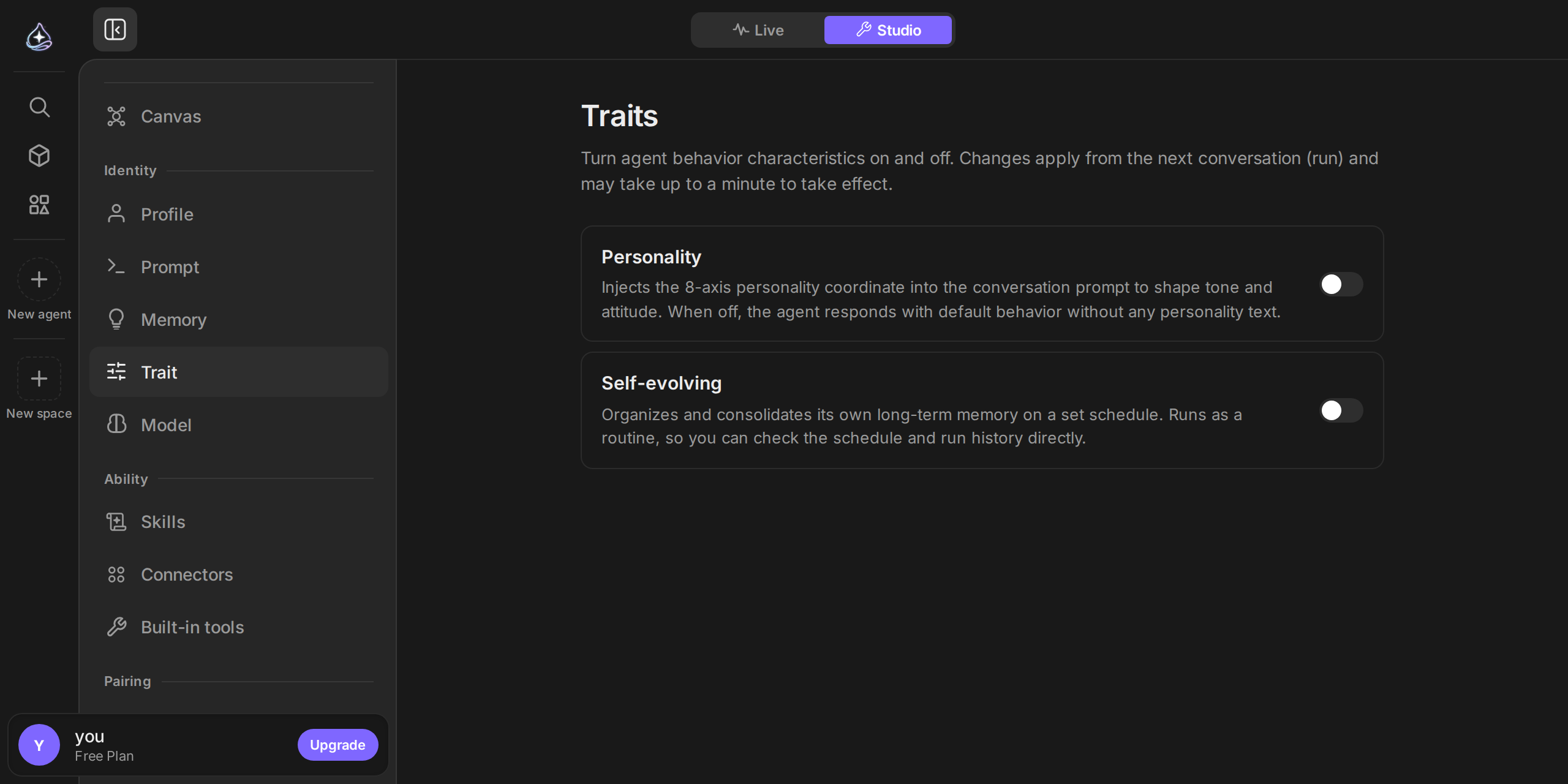
A trait turns one behavior of the agent on or off. Unlike the system prompt, which is text you write, a trait is a switch: the setting stays where it already lives, and the trait decides whether it is used.
The traits
Section titled “The traits”| Trait | What turning it on does |
|---|---|
| Personality | The character you set in the agent’s profile is included in what the model reads. With it off, the agent works from its prompt alone. |
| Self-evolving | The agent reviews and tidies its own memory on a schedule, as a routine you can see and edit like any other. |
When to use them
Section titled “When to use them”Personality is worth turning on when tone matters — an agent that talks to customers, or one whose replies you read all day. Leave it off when you want the agent to be plain and predictable, or when you are tuning a prompt and want one fewer variable.
Self-evolving earns its place on an agent that has been running for weeks and has accumulated memories it no longer needs. On a new agent there is nothing to tidy.
Limits
Section titled “Limits”- Traits are per agent.
- The personality trait does not create a personality; it carries the one already on the profile. Change the character in Identity.
- Self-evolving works through a normal routine, so it is subject to the same rules — including that an unattended run cannot ask you anything.
- Changes apply to the agent’s next run.
Related
Section titled “Related”Identity and profileWhere the character the personality trait carries is set.
MemoryWhat the self-evolving trait tidies.
The context windowTraits are part of what the model reads on every step.