
The agent flywheel: the week revenue passes the token bill
An AI-native company is one where agents find the work, build it, ship it, run it and fix it, and the revenue covers the tokens they use. Once that happens, even by a dollar, the loop pays for its next turn. A worked example over 52 weeks.
On this page
Talk about AI-native companies usually turns to headcount. Money is a more useful test.
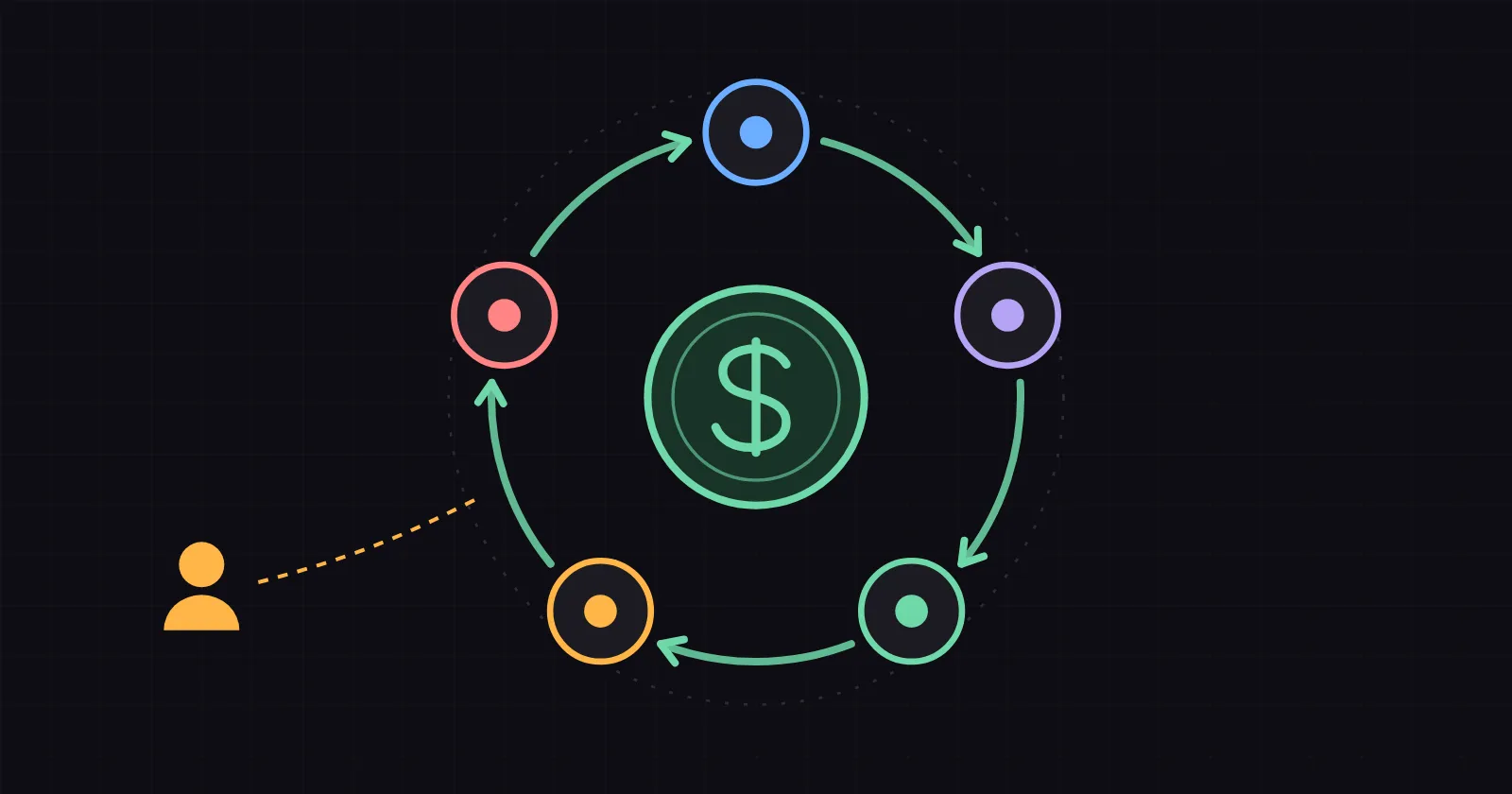
A company is AI native when agents find the work, build the product, ship it, run it and fix it, and the revenue pays for the tokens they use along the way. The first week revenue passes the token bill, even by a dollar, the loop pays for its own next turn. We call that the agent flywheel.
The short version
- Five steps, repeated: find, build, ship, run, fix.
- Agents do the steps. A person sets the budget, approves what cannot be undone and steps in when something keeps failing.
- The wheel starts turning on its own the first week revenue beats tokens and hosting. In the example below, that is week 7, by five dollars.
- After that, the surplus pays for the next product, and the one after it.
1. Five steps, around and around
Take a small example. It starts with one person and two agents.
- Find. A scout agent reads travel reviews and notices a pattern: restaurants near tourist sights lose foreign guests because their menus come in one language. It proposes a product: menus translated into six languages, kept up to date, for $19 a month.
- Build. A small team of agents writes the spec, builds the translation workflow and a signup page, and checks the result against a finish line the person wrote down.
- Ship. The page goes live with a way to pay.
- Run. An agent updates each restaurant’s menus every week and answers owners’ questions.
- Fix. An agent reads failed runs and complaints, such as dish names translated too literally, and ships a fix.
Then the loop goes back to the start. The scout looks for the next gap.
2. The week the wheel starts turning
For the first three weeks there is nothing to sell. The person pays about $50 a week in tokens while the agents build. The product launches in week 4.
In week 7, eleven restaurants are paying. Revenue for the week is $46. Tokens and hosting cost $41. Five dollars ahead.
Five dollars is small, and that is fine. What matters is the sign. From that week on, each new customer adds about three dollars a week after their own tokens, and the work no longer needs money from outside to keep going. The running total is still negative, about −$205 that week. Watch the weekly number. The running total follows it.
3. A year of turns
Here is the rest of the example year. One rule decides when a new product starts: the first one must be paid back, and one week of margin must cover two weeks of building, about $100.
| Week | What happens |
|---|---|
| 6 | Bottom of the running total, about −$210 |
| 11 | Paid back |
| 15 | Product 2 launches: listing refreshes for vacation rental hosts, $15 a month |
| 22 | Product 3: a grant deadline digest for small nonprofits, $12 a month |
| 29 | Product 4: a spare-parts finder for bike repair shops, $25 a month |
| 52 | 609 customers, $2,335 revenue against $746 of tokens and hosting that week, $40,134 ahead in total |
By week 52 there are 17 agents. There is still one person.
This is an example model, built to show the shape. Your prices, costs and customers will be different. The shape tends to hold: a dip while you build, a first week ahead, then a curve that bends upward as each product pays for the next.
4. What the person still does
Most of the work moves to agents. Three jobs stay with a person.
- The budget and the stop line. How much the first product may spend before it earns, and when to stop one that does not.
- Approvals. Charging customers, sending messages and deleting data wait for a yes.
- Repeated failures. A one-off error is the fixer agent’s job. The same error three times is a signal for a person.
So what should you do?
- Pick a niche where the weekly work repeats and the price fits in one sentence.
- Track one number per product, every week: revenue minus tokens and hosting.
- Give each product its own budget, so its cost shows up on its own.
- Write the rule for starting the next product before you need it. Ours: paid back, and one week of margin covers two weeks of building.
- Write the rule for stopping, too. For example: four weeks below zero after launch, and the agents move to the next idea.
Where endue fits
No tool runs this whole loop without people today, endue included. The table shows which parts work now.
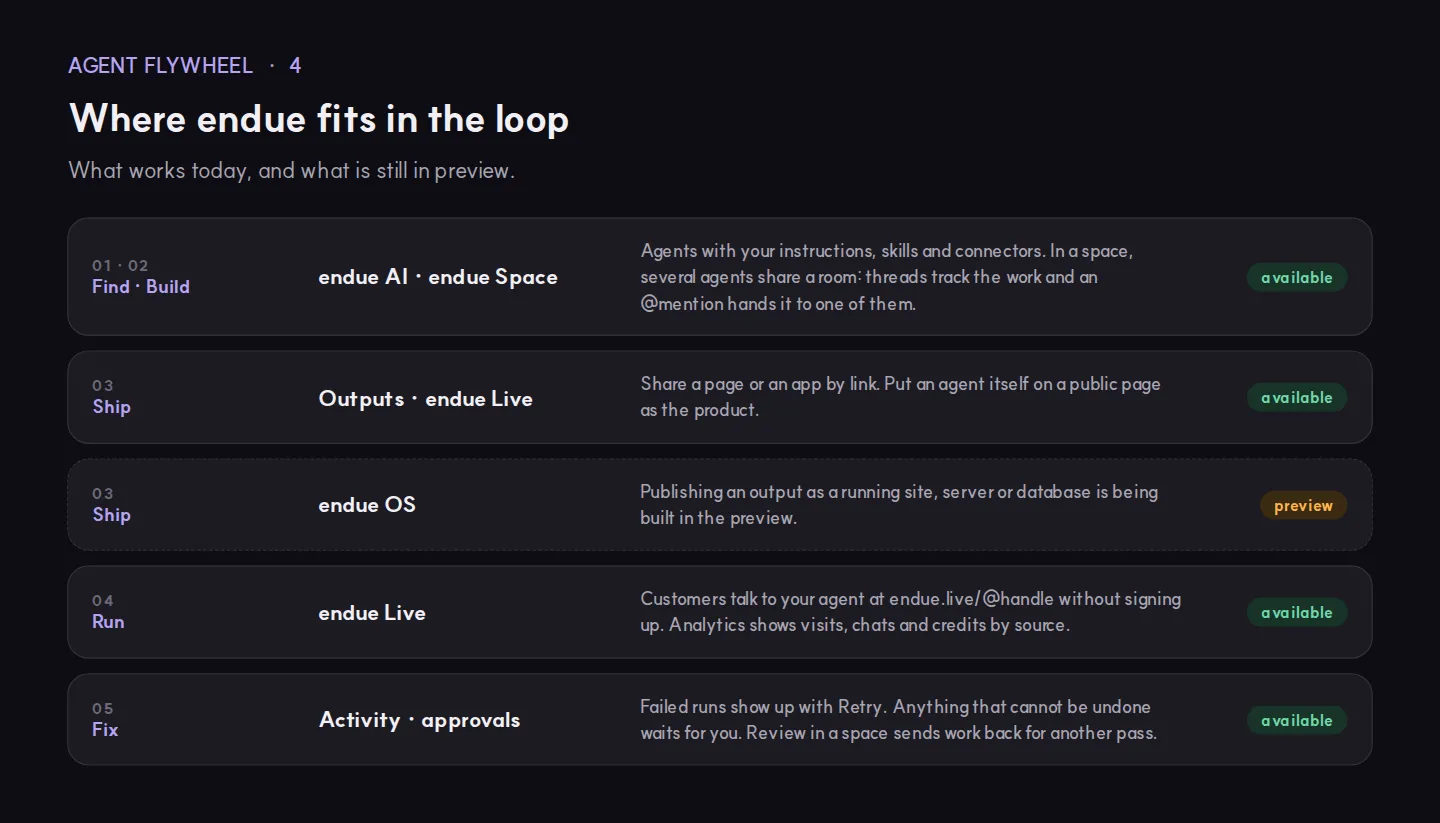
- Find and build with a team. In endue, each agent has its own instructions, skills and connectors. In a space, several agents work in one room: threads keep track of each piece of work, and an @mention hands a piece to one agent.
- Ship. You can share a page or an app your agents made with a link (Outputs). You can also put an agent itself on a public page as the product. Publishing an output as a running site, server or database is what we are building in the endue OS preview. It is not available yet. Charging customers also happens outside endue for now: there is no paywall or payment connector in endue.
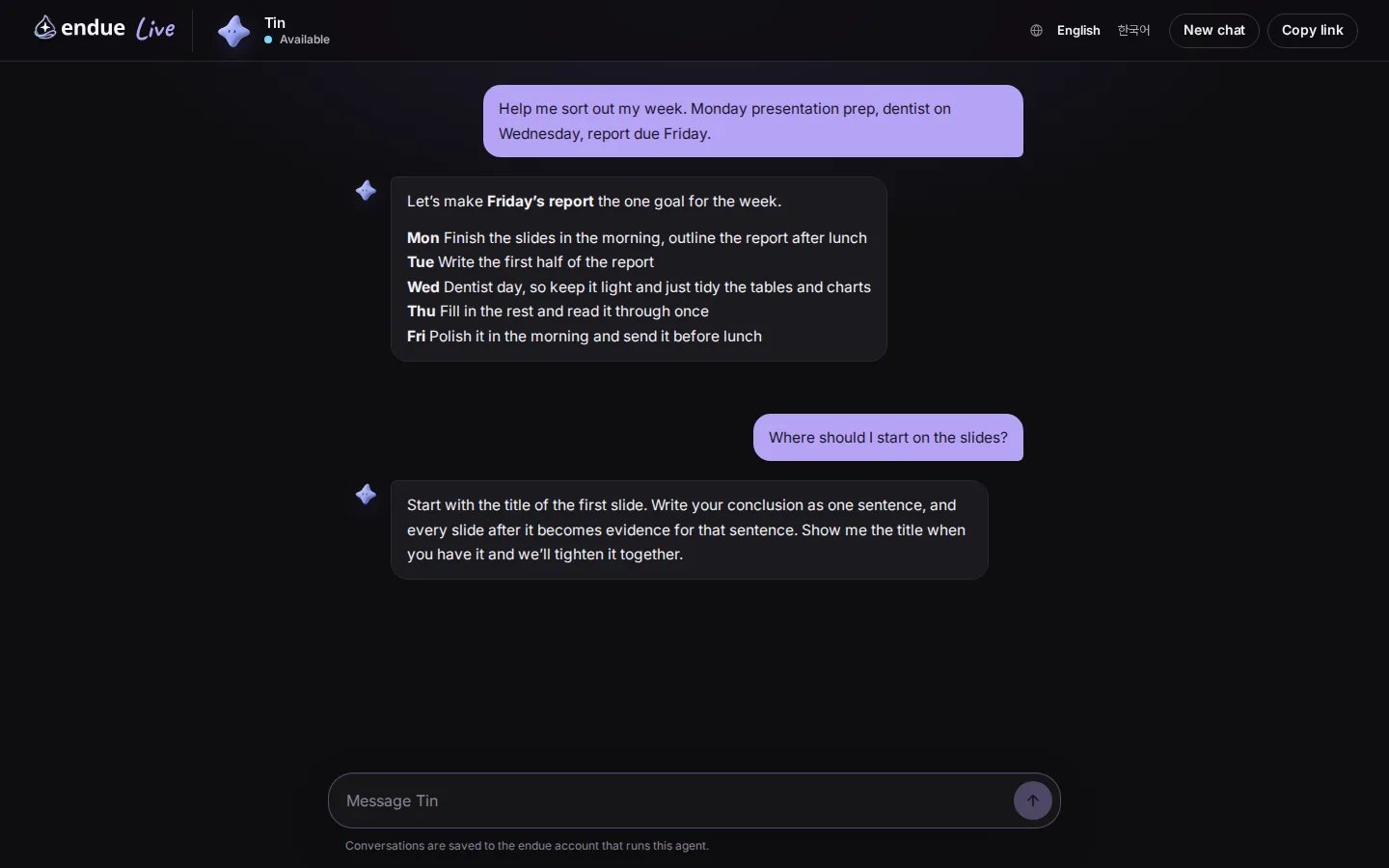
- Run with endue Live. Customers talk to your agent at
endue.live/@handlewithout signing up.
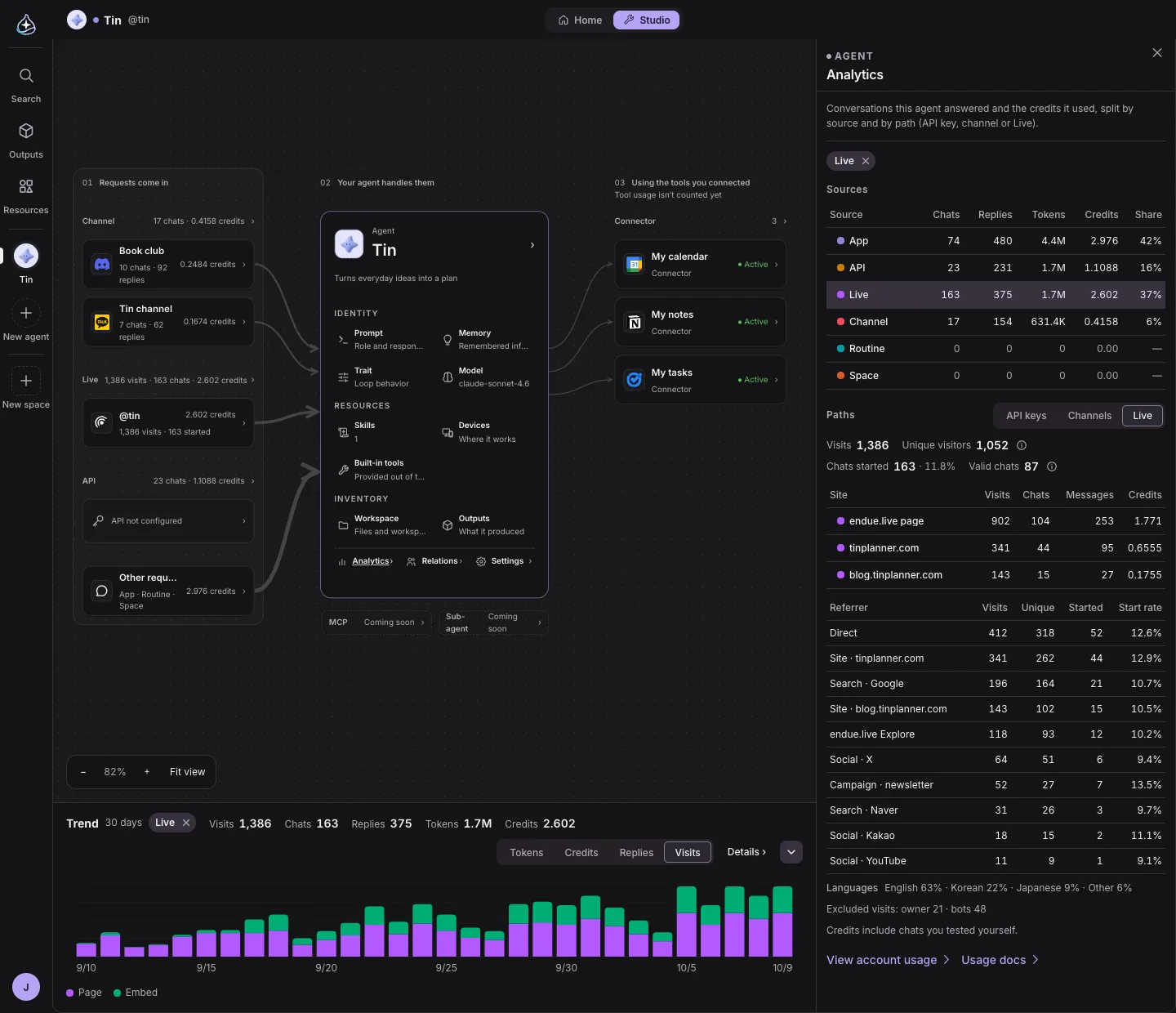
- See both sides of the weekly number. Analytics shows visits and chats per source next to the tokens and credits they used. Combine it with what customers pay you, and you have the weekly number. A key of its own per agent (bring your own key) keeps each product’s cost apart.
- Fix. The Activity board shows failed runs with Retry. Anything that cannot be undone waits for your approval.
The money side of this loop is covered in an agent economy starts with identity, and the machine side in four things an agent harness has to do.
Start with one product and one number. The first week that number turns positive, the wheel turns on its own.
Try it in endue
Make an agent from one goal
Help me set up an agent that sends me a short briefing on my field every morning at 8.
Free foreverNo card requiredNothing runs until you press Send